The Faster You Go, The Slower You Get

How to read the warning signs before your season goes off the rails
It's 3:00 AM. You're wide awake, heart going like you're mid-transition — but you're just staring at the ceiling.
You've hit every power target this month. You've logged the miles. By any measure, you're the hardest worker in your local tri club.
So why did your tempo run yesterday feel like wading through wet concrete?
You haven't hit a new fitness peak. You've hit the edge of a physiological cliff.
I see this every season — athletes who are training hard but going slower, digging deeper but getting less. This post is about how to recognize that pattern before it takes your race with it.
The Performance Paradox: More Work, Worse Results
The biggest myth in endurance sport is that fitness happens during the workout. It doesn't.
The science on this has been settled for decades. The classical Banister model — still the most widely validated framework in training science — puts it simply:
Performance = Fitness − Fatigue
Fitness builds slowly. Fatigue builds fast. The whole point of structured training is to time it so fitness outlasts fatigue right when your race arrives.
When recovery gets shortchanged repeatedly, fatigue doesn't clear. Fitness stagnates. Performance goes backwards — no matter how many hours you're putting in.
That's the Performance Paradox: the harder you dig without recovering, the deeper the hole.
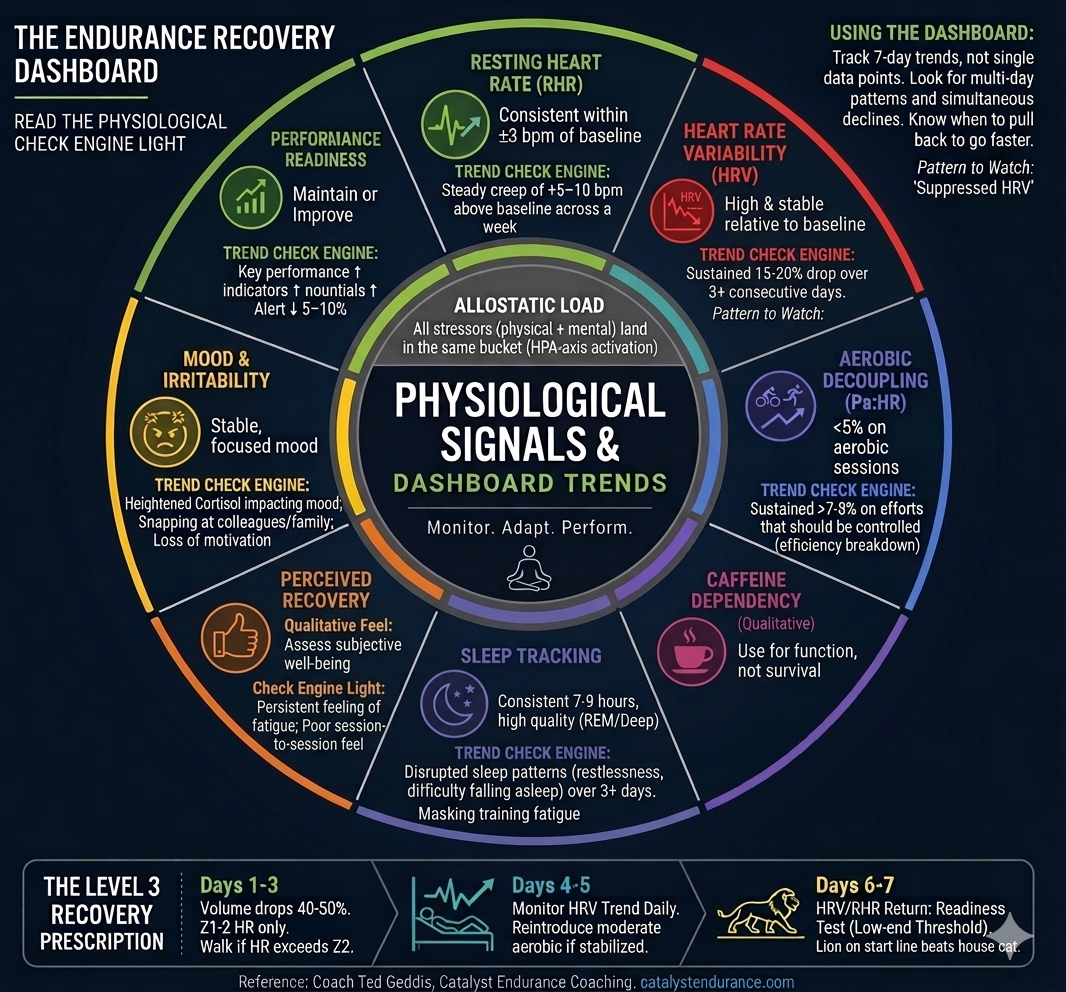
Here's the other thing most athletes don't account for: your body doesn't sort stress by source. A 20-mile long run and a 60-hour week of back-to-back meetings land in the same physiological bucket. Research on allostatic load is clear that occupational and psychological stress triggers the same hormonal cascade as hard training. When that bucket overflows, your A-race is the first thing to drown.
Most of my athletes aren't overtrained. They're under-recovered — and that's a solvable problem if you catch it early enough.
True Overtraining Syndrome is actually rare. It can take months to resolve and sometimes needs medical intervention. What I see far more often is non-functional overreaching — a state where your load has exceeded your capacity to adapt. Performance drops, mood tanks, motivation disappears. Caught early, it resolves in days to a couple of weeks. Ignored, it becomes something much harder to dig out of.
Reading the Dashboard: Your Check Engine Light
Your Garmin, Oura, or Whoop is a diagnostic tool. The problem is most athletes check individual data points rather than patterns.
I don't care about a single red day. Anyone can have a rough night. What I care about is the trend.
I use rolling 7-day averages with my athletes. One data point is noise. Three days in the same direction is a pattern. Five days is a physiological signal that demands a response.
Here's what the check engine light actually looks like:
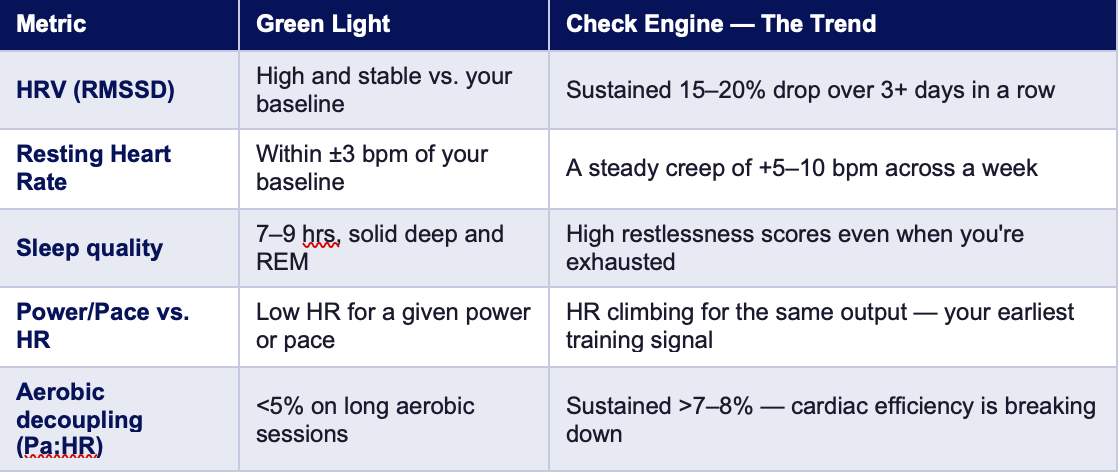
Two things worth knowing about this table. First, on HRV: the research from exercise physiologist Dan Plews and colleagues shows that what matters most isn't your absolute HRV score — it's the trend of your weekly rolling average versus your longer-term baseline. A sustained drop alongside rising resting HR is one of the clearest early signals we have.
Second, aerobic decoupling (Pa:HR or Pw:HR in TrainingPeaks) often gets overlooked, but it's one of the most actionable metrics in the table. If your heart rate is climbing disproportionately to maintain the same pace or power on long aerobic efforts — and it's happening session after session — your system is telling you it's under strain. No extra hardware required. It's right there in your data.
What the Watch Can't See
Numbers tell most of the story. But some of the clearest signals are the ones you feel, not the ones you track.
If you're experiencing any of these, it's time to act — not push through.
• The Third Cup Problem. If you need three cups of coffee just to feel ready for a Zone 2 ride, your central nervous system is taxed. That's not a caffeine habit — it's your body telling you the adaptation you're chasing isn't happening.
• Irritability and short fuse. Chronically elevated cortisol from training stress directly disrupts mood regulation. Snapping at your family or losing patience at work over small things isn't a personality issue. It's a hormonal one — and it's one of the most reliable early indicators of overreaching in the research.
• Dreading the next session. When an athlete who loves their sport starts dreading workouts — or feels disconnected from a race they've been building toward for months — that's the nervous system running a protection protocol. It's not a motivation problem. It's a signal to respect.
What to Do About It: The Strategic Pivot
The hardest part of being an age-group athlete isn't the discipline to work. It's the discipline to stop when the data tells you to.
If multiple metrics are moving in the wrong direction at the same time — HRV down, resting HR elevated, decoupling rising, mood off — don't wait for your next planned recovery week. Start now.
In practice, this is what a targeted recovery intervention looks like:
• Days 1–3. Volume drops to 40–50% of the previous week. Every session is Zone 1–2 by heart rate — not pace, not power. If your HR creeps above Zone 2 on an easy run, you walk. Sleep becomes the primary training stimulus.
• Days 4–5. Monitor your HRV trend daily. If it stabilizes or starts to recover, cautiously reintroduce moderate aerobic work. If it continues to drop, extend the protocol. You're reading readiness — not guessing at it.
• Days 6–7. If HRV is returning toward baseline and resting HR is settling, a single session at low-end threshold can be used as a readiness test. Your aerobic decoupling on that session will tell you whether your system is genuinely ready to absorb load again.
I would rather you arrive at the start line 10% undertrained and physiologically primed than 1% overtrained and running on cortisol. A lion on the start line beats a house cat every time.
Stop Guessing. Start Progressing.
Most athletes train hard. Few train right.
The difference isn't talent or hours — it's having an objective lens on your own data. Knowing when to hammer and when to heal, based on what your physiology is actually telling you.
If you're staring at the lines on your Garmin graph or the numbers in TrainingPeaks and wondering whether you're building fitness or burning out, that uncertainty is costing you performance. The data is already there. The question is whether you have the framework to read it.
That's exactly what a Coach Consultation with Catalyst Endurance Coaching is built around. We'll look at your HRV trends, decoupling history, training load, and subjective patterns — and give you a clear picture of where you are and what your season needs next.
Ready to see what your data is actually telling you?
Book a Coach Consultation at catalystendurance.com
Want to Go Deeper?
The science behind this post draws on some of the most cited research in endurance training physiology. If you want to explore the evidence yourself, these are worth your time:
• Meeusen et al. (2013) — The ECSS/ACSM joint consensus statement on overtraining syndrome. The definitive reference on OTS vs. non-functional overreaching.
• Kreher & Schwartz (2012) — Overtraining syndrome: A practical guide. Sports Health, 4(2). Excellent on the qualitative and hormonal markers.
• Plews et al. (2012, 2013) — Heart rate variability in elite endurance athletes. International Journal of Sports Physiology and Performance. The foundation for HRV trend interpretation.
• Halson & Jeukendrup (2004) — Does overtraining exist? Sports Medicine, 34(14). Supports the under-recovery framing.
• Banister et al. (1975) — A systems model of training for athletic performance. The original Impulse-Response model underpinning the Fitness − Fatigue equation.