Run Shoes: It's Not Just Who You Are, It's What You're Doing Today
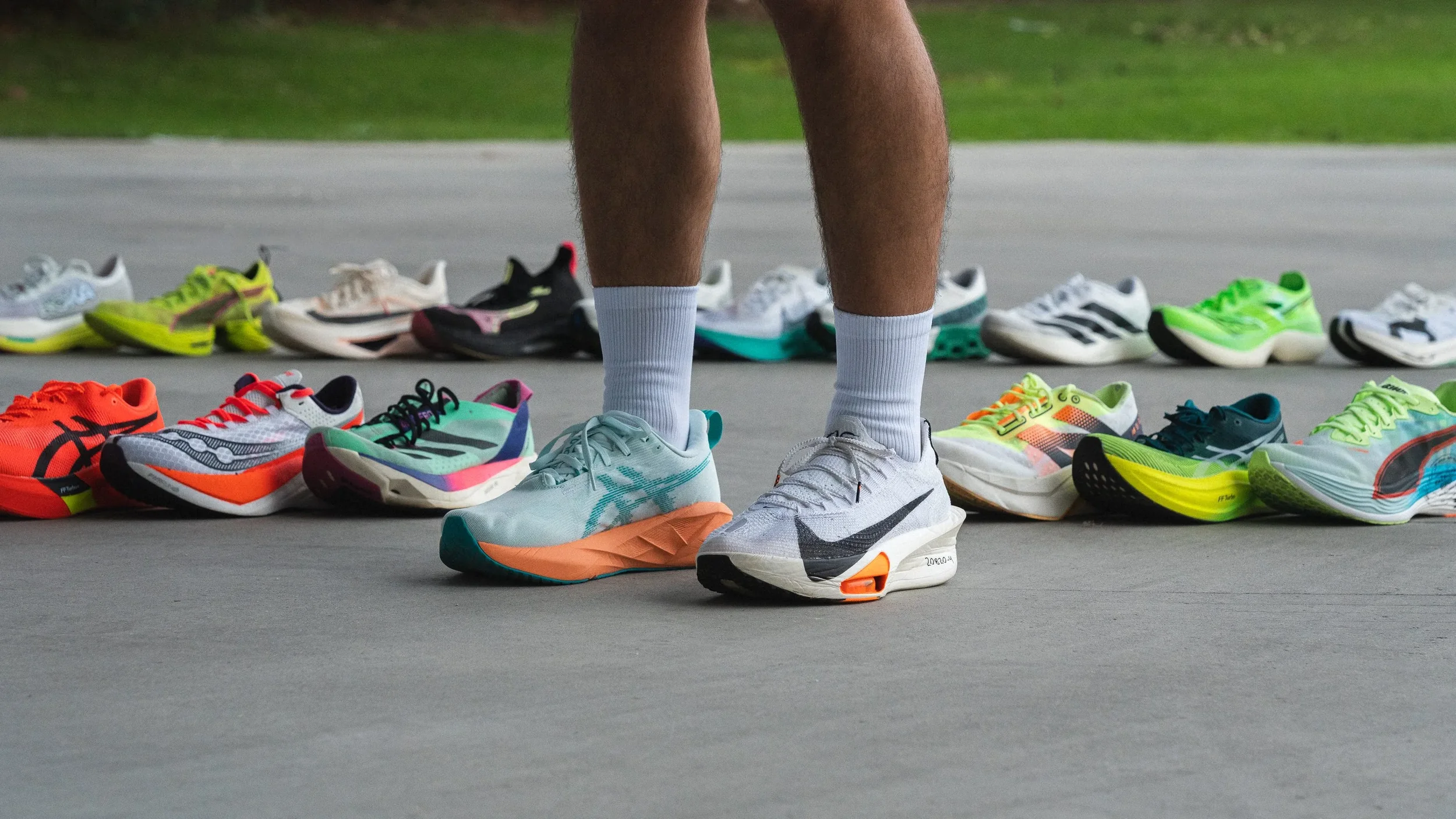
Everyone wants one shoe. One box, one answer, done. I get it — shopping for shoes is annoying and the wall at the running store looks like a chemistry experiment gone rogue. But here's the truth nobody wants to hear: the “right” shoe isn't a fixed answer, it's a moving target. It depends on where you are as an athlete and what you're asking your legs to do that day. A brand-new runner and a fifteen-year veteran shouldn't be shopping the same way. And that same veteran shouldn't be wearing the same shoe for an easy Tuesday jog, a track workout, and a race. Let's break down both axes — then deal with the noise everyone's currently obsessing over.
Axis One: Who You Are
The New Athlete
Please, for the love of your tibia, don't buy shoes because they're teal. Get fitted. A decent specialty running store will watch you jog for fifteen minutes and tell you something useful about how you move. That fifteen minutes might be what keeps you off crutches in month three.
That said — don't overthink the “pronation control” piece either. The research on matching shoes to foot type has actually shifted quite a bit. Researchers have found that recommending footwear based on static foot posture or how much the foot rolls inward during stance isn't well supported, and that heavily controlling foot motion through motion-control shoes can even backfire. What actually predicts success is something almost embarrassingly simple: comfort. Shoes that feel right — not too stiff, not too mushy, not too narrow, not too wide — tend to perform better for the person wearing them than shoes chosen off a foot-type chart.
One exception: if you've got a history of pronation-related injuries — shin splints, certain tendon issues — a stability shoe does show a real protective benefit specifically for you. Your fitting should include your injury history, not just a video of your stride.
The Seasoned Veteran
By now you know your feet better than any store clerk will in fifteen minutes. You know if you eat outsoles or crush midsoles. Buy from what's worked — not from what's trending on Strava this week.
This is also the athlete who benefits most from rotating shoes, and this isn't just old-school folklore. Runners who used more than one shoe in parallel — rotating models rather than living in a single pair — were injured at a meaningfully lower rate than the group as a whole in one of the better-known studies on this topic. The leading theory isn't really about the foam “resting” between runs — it's about variety in loading. Different shoes shift stress across slightly different tissues, so nothing gets hammered the exact same way, run after run. If you're running four-plus days a week, a second pair in a genuinely different model (not just a different colorway of the same shoe) is one of the cheapest injury-prevention tools available to you.
Axis Two: What You're Doing Today
This is the piece most runners skip, and it's arguably more important than the “who” question.
The Long Slow Day
This is your durability shoe. Max cushion, forgiving ride, the model built to absorb hour after hour of low-intensity volume without beating up your legs. This is not the shoe you save — it's the shoe you run into the ground, because its whole job is protecting you on the days you're logging time, not chasing pace.
The Track Session
Different job entirely. On the track you want something lighter and more responsive — you're not trying to survive two hours, you're trying to hit 400s at pace without your shoe fighting you. A daily trainer here will feel like running in cement compared to a snappier trainer or a lightweight racer-adjacent shoe. A firmer, more ground-connected ride actually helps your form under speed, rather than working against it.
Race Day
This is where the modern “super shoe” — carbon plate, high-rebound foam — earns its price tag, and this one's actually well-supported in the literature, not just marketing. Controlled studies have found these shoes lower the metabolic cost of running by roughly 4% compared to conventional racing shoes, with other trials putting the improvement in the 2.6% to 4.2% range compared to traditional footwear. That's a real, physiologically-measured advantage — not just a marketing claim. But it's a race-day tool, not a training shoe. Save it. Run your key workouts and races in it; don't burn its lifespan jogging to the mailbox.
The Super Shoe Noise
Here's where I need to pump the brakes on some of you specifically. You know who you are — you saw a stranger run a 15-minute 5K PR in a pair of $260 foam rockets on Instagram and now you're wondering if your Tuesday club run needs them too.
Let's separate the real signal from the noise.
The signal: these shoes work. The energy return from the plate and foam genuinely lowers the metabolic cost of running, and that's been shown in controlled lab conditions, not just marketing copy. But — and this matters — most of that benefit was measured on elite and highly-trained runners at race pace. The effect is still real at recreational speeds, but it tends to be smaller and more individual than the ads suggest, and comfort and stability start mattering just as much as the plate itself once you slow down. The shoe on an elite's foot at a record-setting marathon doesn't automatically translate into a PR for your weekend long run buddy. Training, fueling, and years of aerobic development did most of that work — the shoe is a multiplier, not a substitute.
The noise: there's a real cost to living in these shoes full-time, and it's not just financial. Case reports have documented navicular bone stress injuries — a nasty, slow-healing injury — in runners who used carbon-plated shoes heavily, and the working theory is that the stiff plate and tall, bouncy foam shift stress into the midfoot and forefoot in ways your bones and tendons haven't adapted to if you jump in too fast.
To be clear: no research has shown that super shoes directly cause bone stress injuries in a general population. The risk concentrates in a specific profile — runners with a prior bone stress injury, low bone density, chronic underfueling, or a heavy racing-season volume spike — and women are affected at more than double the rate of men. If none of that describes you, the risk calculus looks very different.
The practical takeaway I give my athletes: these shoes get earned gradually, not adopted overnight. Introduce them over roughly eight weeks, cap them at somewhere around 20% of your weekly mileage until your body's used to the new loading pattern, and keep rotating in a standard trainer for the rest of your volume. Treat the super shoe like what it actually is — a race-and-key-workout tool, not a daily driver, and definitely not a shortcut that replaces the boring aerobic base miles that got the elites there in the first place.
Putting It Together
A new athlete on a long slow day needs a well-fitted, comfortable daily trainer. A seasoned veteran on race day needs the carbon-plated shoe they've already practiced in — never debuted cold, and never overused in training just because it feels good. The matrix matters more than either axis alone: your experience level tells you how to shop, the session in front of you tells you what to put on your feet, and the hype cycle should tell you nothing at all.
Get fitted, listen to comfort over charts, rotate if you're logging real mileage, and earn your way into the super shoe instead of jumping in with both feet. That's how you raise your run IQ.
Ready to train smarter?
Get a shoe strategy — and a training plan — built around you.
References
Nigg, B.M., Baltich, J., Hoerzer, S., & Enders, H. (2015). Running shoes and running injuries: mythbusting and a proposal for two new paradigms: 'preferred movement path' and 'comfort filter.' British Journal of Sports Medicine, 49(20), 1290–1294.
Willems, T.M., Ley, C., Goetghebeur, E., Theisen, D., & Malisoux, L. (2021). Motion-control shoes reduce the risk of pronation-related pathologies in recreational runners: a secondary analysis of a randomized controlled trial. Journal of Orthopaedic & Sports Physical Therapy, 51(3), 135–143.
Malisoux, L., Ramesh, J., Mann, R., Seil, R., Urhausen, A., & Theisen, D. (2015). Can parallel use of different running shoes decrease running-related injury risk? Scandinavian Journal of Medicine & Science in Sports, 25(1), 110–115.
Hoogkamer, W., et al. (2018). A comparison of the energetic cost of running in marathon racing shoes. Sports Medicine.
Barnes, K.R., & Kilding, A.E. (2019). A randomized crossover study investigating the running economy of highly-trained male and female distance runners in marathon racing shoes versus track spikes.
Tenforde, A.S., et al. (2023). Bone Stress Injuries in Runners Using Carbon Fiber Plate Footwear. Sports Medicine, 53(8), 1499–1505.
Wang, W., et al. (2026). Performance Benefits Without Added Injury Risk? Effects of Advanced Footwear Technology on Running Economy and Biomechanical Risk in Recreational Runners. Scandinavian Journal of Medicine and Science in Sports, 36(4), e70275