What is your Athlete Archetype

If you've ever followed a training plan to the letter—nailing every workout, hitting your zones, checking all the boxes—and still felt like something wasn't quite clicking, you're not alone. Maybe you're hitting your prescribed power/pace numbers but getting dropped on every climb. Or crushing intervals but bonking in races. Or training exactly like your faster teammate but not seeing the same improvements.
Here's the uncomfortable truth: your training might be perfect—for someone else.
The Problem with One-Size-Fits-All Training
Let me introduce you to two of my athletes, Sarah and Jake. Both targeting Ironman. Both with watts/kg of around 3.8. On paper, identical athletes who should be following identical training. Six months into the season, one crushed her race with a 20-minute PR. The other struggled, missed his time goal, and felt frustrated despite perfect training compliance.
What went wrong?
When we looked at their power-duration curves, the answer became crystal clear. Amanda had lower short power (350W) but held her watts rock-solid for hours. Daniel had exceptional 1-minute power (420W) but his endurance durability fell off quickly. Same watts/kg. Completely different physiological profiles. And here's the kicker—they needed opposite training prescriptions. This is the fundamental problem with using just Threshold Testing alone to guide training. Threshold Testing tells you one data point on your power curve. But your entire curve—how you produce power across all durations—matters far more for determining what training your body actually needs.
Enter the Catalyst Endurance Coaching Athlete Archetype Assessment, A3, for short.
What Is the Athlete Archetype Assessment, A3?
The Athlete Archetype Assessment is a framework built on decades of exercise physiology research into the Critical Power model. It compares two key markers on your power-duration curve:
Critical Power/Pace (CP): Your sustainable threshold power—roughly a 30-60 minute maximal effort. This is the boundary between 'hard' and 'really freaking hard.' It represents the highest metabolic steady state you can maintain.
VO2max Power/Pace: Your maximal aerobic capacity—roughly a 5-8 minute maximal effort. This is the ceiling of your aerobic engine, the highest power output you can sustain while still relying primarily on aerobic metabolism.
By looking at the ratios of these numbers and using a proprietary algorithm comparing outputs and hearts at various distances to insure accuracy of the results , we get a percentage that reveals your athlete archetype.
And understanding your archetype changes everything about how you should train.
The House Metaphor
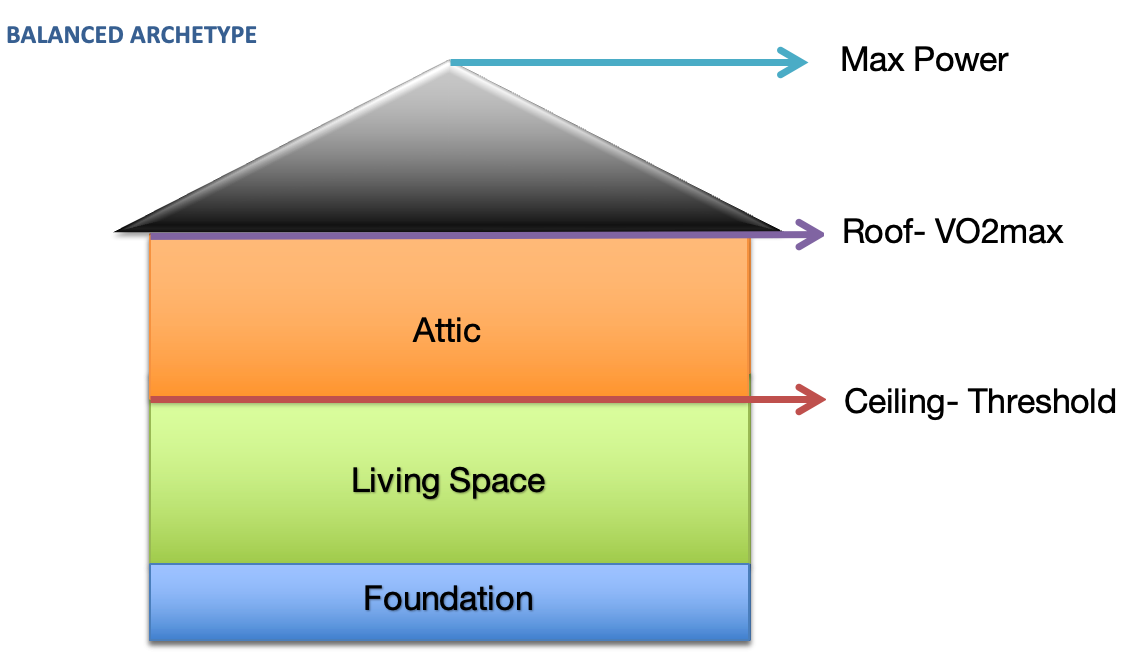
Think of your aerobic capacity as a house with an attic. Your VO2max is the roof—the absolute top. Your Critical Power/Pace is the ceiling—the highest level where you can actually 'live' sustainably. The space between them is your attic. Different athletes have very different attic spaces. And the size and position of your attic space determines what kind of training you need.
The Three Archetypes Explained
THE AEROBIC ATHLETE
Profile:
Your ceiling is almost touching your roof—you have a very small attic space. you're an aerobic athlete. What does this mean in practice? You have an exceptionally strong endurance base. You can ride or run steady for hours. Your aerobic system is highly developed. But your top-end power—your ability to surge, attack, or respond to sharp accelerations—is limited relative to your endurance capacity. You're the athlete who crushes long, steady efforts but gets dropped on every climb. Hills hurt. Surges hurt. You're strongest when the pace is consistent.
What You Need:
RAISE THE ROOF. You need to push your VO2max higher to create more attic space. Your aerobic base is already strong—in fact, your CP is approaching your VO2max ceiling. More endless Zone 2 miles won't help. You need intensity.
Training Prescription:
• 70% low intensity (Zone 1-2): Maintain your aerobic base
• 30% high intensity: VO2max intervals (4-8 min @ 110-120% FTP), threshold work, anaerobic capacity
• Key sessions: 1x/week VO2max intervals, 1x/week threshold, the remainder easy aerobic maintenance
Real Athlete Example: Amanda
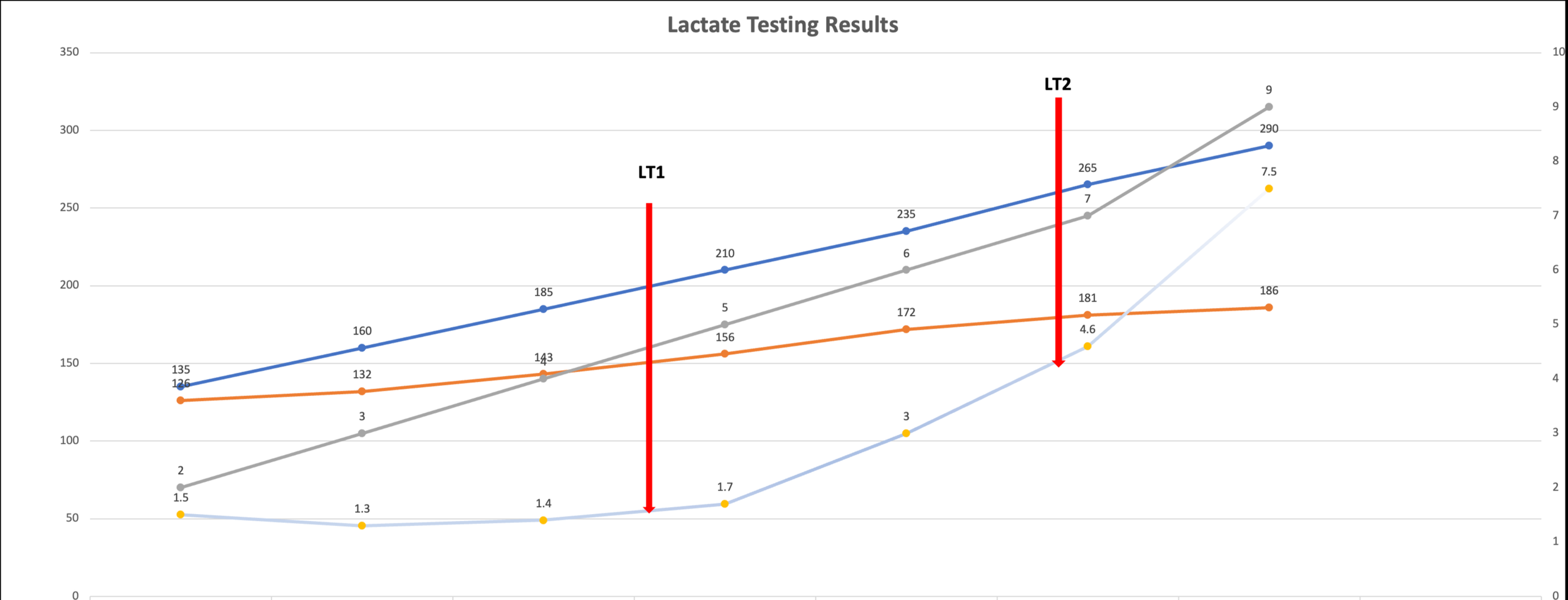
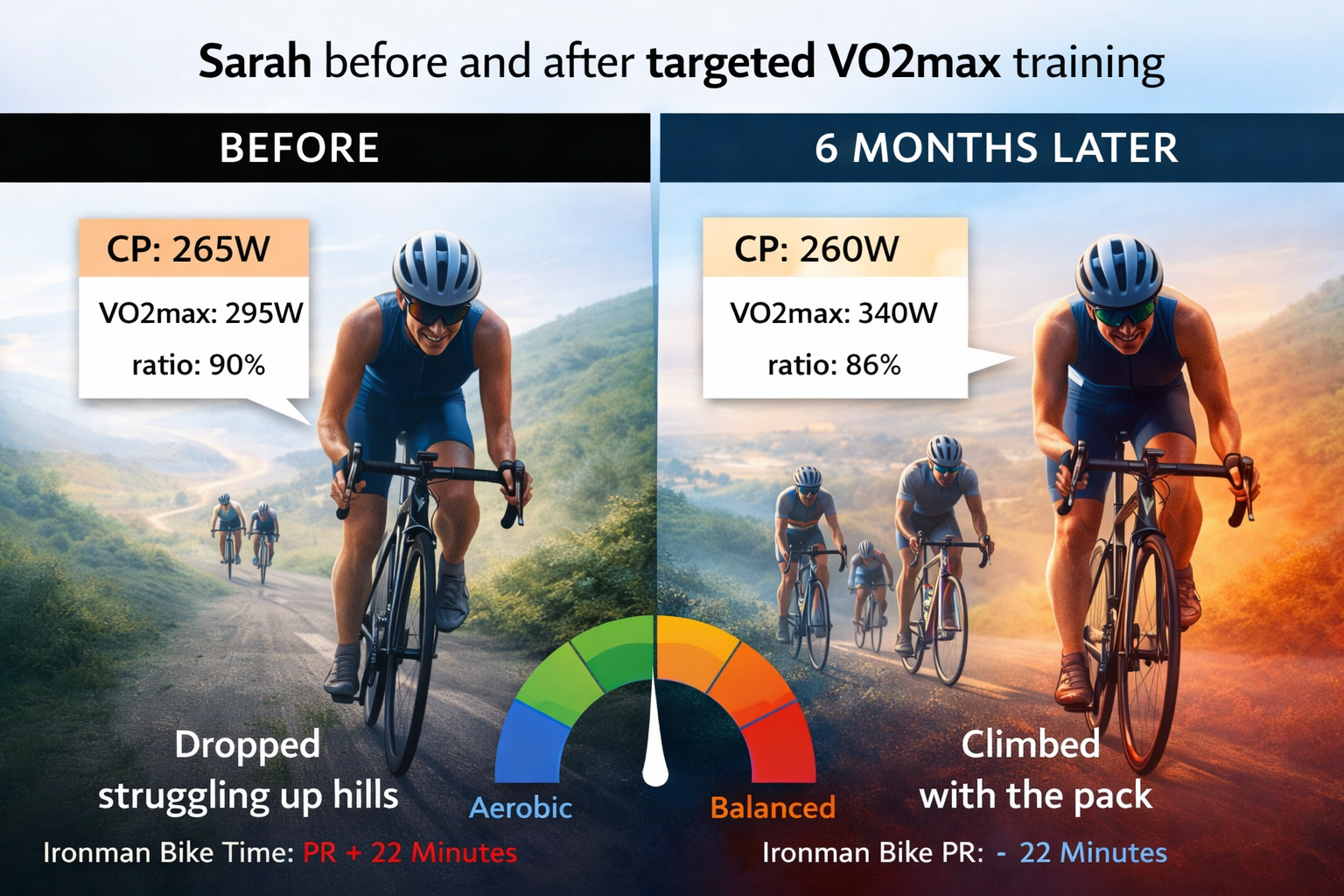
Amanda came to me with a 90% ratio (CP: 265W, VO2max: 295W). She was an Ironman athlete who could ride steady all day but struggled on hilly courses. Her instinct was to add more volume—'I just need more miles. Instead, we reduced her overall volume by 10% and added two weekly VO2max sessions. We focused on raising that VO2max ceiling.
THE BALANCED ATHLETE
Profile:
You have optimal attic space. Good room between ceiling and roof. You're a balanced athlete. Balanced athletes have a well-rounded physiological profile. You can handle both volume and intensity. You perform well across various race distances. You're not exceptionally strong in any one area, but you're competitively capable everywhere. This is the target zone for most competitive long-course racing. It means you have BOTH aerobic capacity AND power reserve.
What You Need:
MAINTAIN BALANCE. Your goal is to keep both systems well-developed through intelligent periodization. Traditional polarized or pyramidal training works excellently here.
Training Prescription:
• 75-80% low intensity (Zone 1-2): Maintain aerobic foundation
• 15-20% threshold work: Sweet spot, tempo, threshold intervals
• 5-10% high intensity: VO2max and anaerobic work
The critical mistake balanced athletes make? Training constantly in Zone 3—'no man's land.' You end up doing medium everything and never truly stressing either system.
True polarization is key: easy is EASY, hard is HARD. Don't live in the gray zone.
THE ANAEROBIC ATHLETE
Profile:
Your ceiling is way below your roof—you have a large attic space, but your ceiling is too low to use it effectively. You're an anaerobic athlete. You have high top-end power but an underdeveloped aerobic base. You can produce big watts or fast paces for short bursts. Your max power numbers look great. But you struggle with long, steady efforts and you fade in races. You're the athlete who crushes intervals but bonks at mile 18 of the marathon. Who hammers the first hour of the ride but suffers the last two. Who finds it almost impossible to keep 'easy' truly easy.
What You Need:
RAISE THE CEILING. You need to elevate your CP up toward your existing VO2max roof. Your roof is already high—your VO2max is good. But you can't access that potential because your sustainable power ceiling is too low. This requires extensive aerobic base building. Zone 2 volume is absolutely critical. And here's the hard part: you need patience. Building aerobic capacity takes months, not weeks.
Training Prescription:
• 85-90% low intensity (Zone 1-2): LOTS of easy aerobic work
• 10-15% threshold/tempo work: Controlled, sustainable efforts
• 0-5% high intensity: Minimal—maybe one session every 2 weeks
Real Athlete Example: Daniel
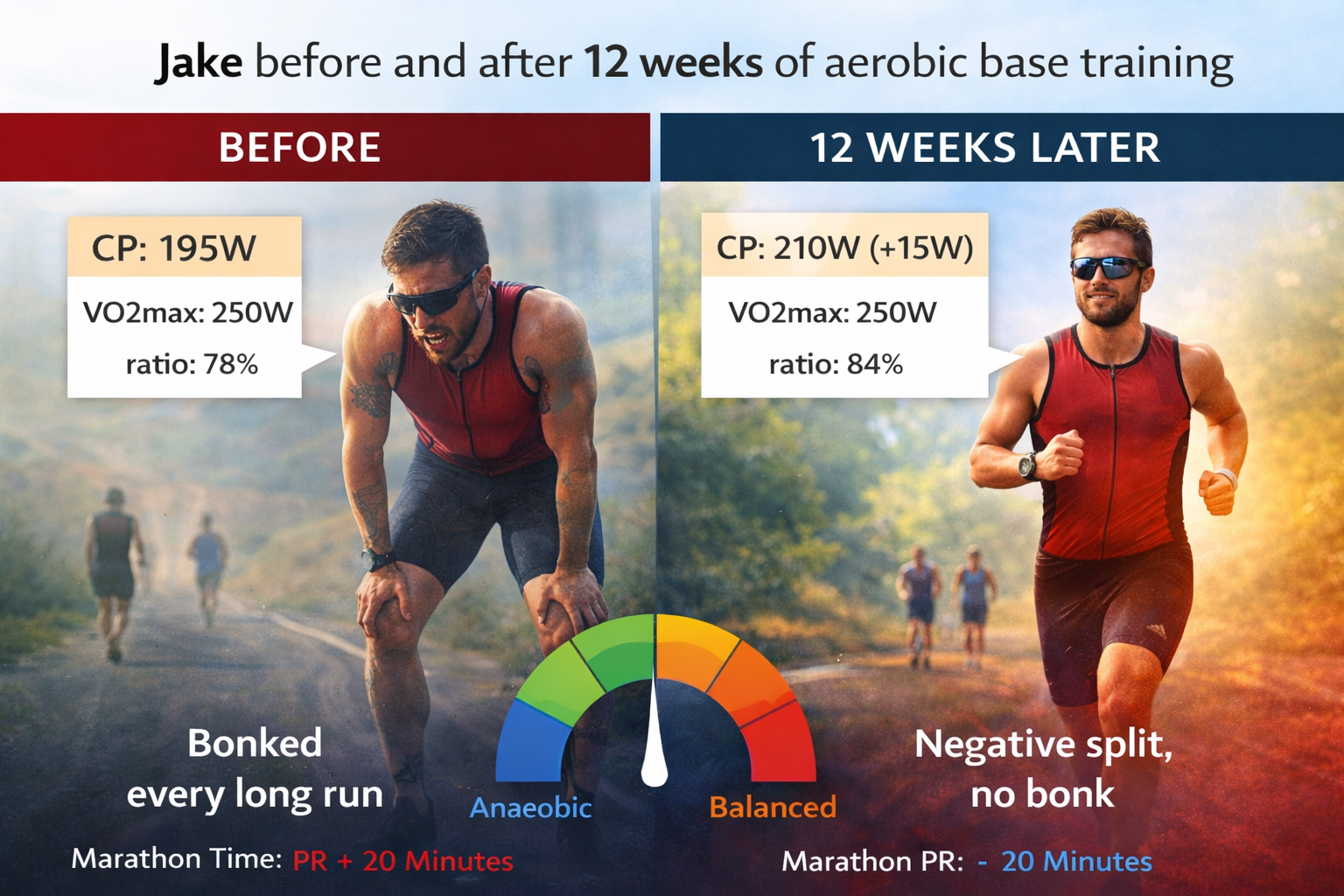
Daniel was a powerlifter turned triathlete. Testing revealed a 78% ratio (CP: 195W, VO2max: 250W). He loved crushing intervals. 'No pain, no gain' was his motto. But he bonked in every session longer than 1.5 hours.
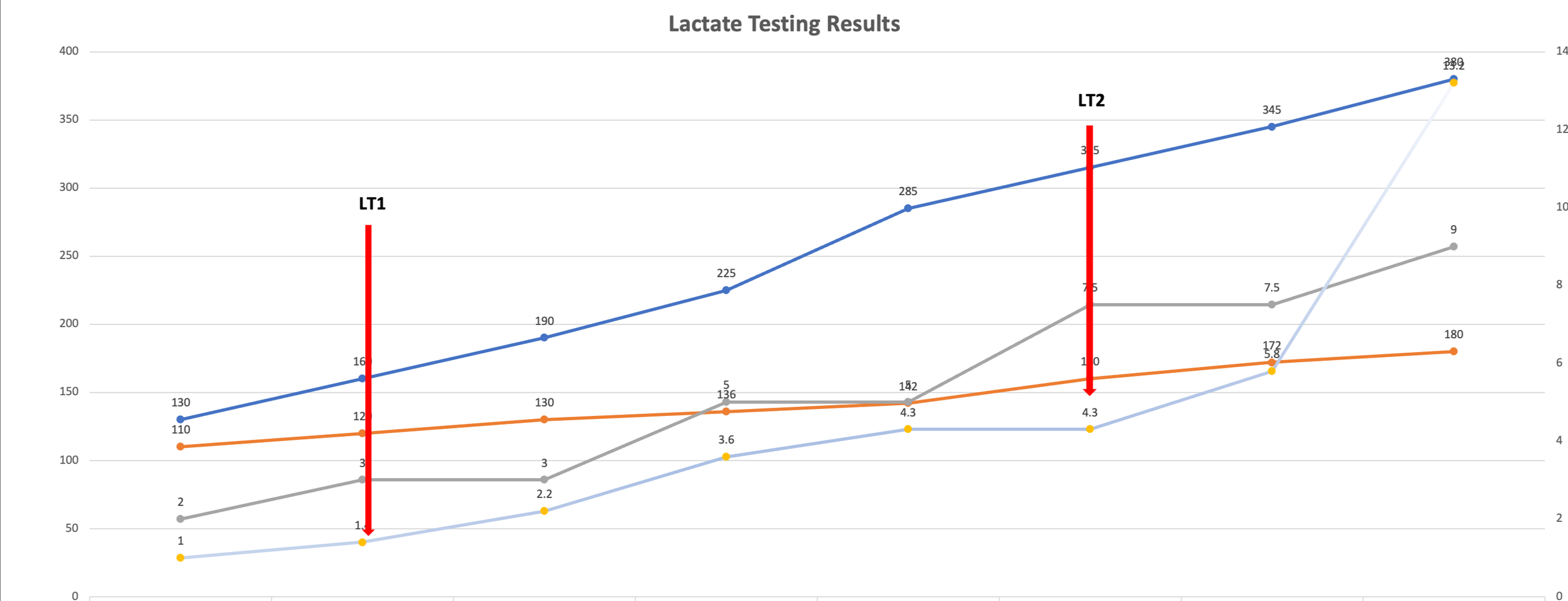
His prescription was counterintuitive: 85% easy volume, one tempo session per week, high-intensity work every other week only. For 12 weeks, we built his aerobic foundation. The hardest part? Keeping him from going too hard on easy days. Learning to truly run easy felt 'wrong' to him. The result: CP jumped to 210W (+15W), VO2max maintained at 250W, ratio improved to 84%. His race result: 20-minute marathon PR, negative split, no bonk. He'd raised his ceiling to access his existing roof.
Why This Matters More Than You Think
Understanding your archetype explains phenomena that have likely frustrated you:
Why you're a 'non-responder' to certain training: You're not a non-responder. You're just following the wrong prescription for your physiology. Research by Montero and Lundby has thoroughly debunked the myth of exercise non-responders. The problem isn't your genetics—it's the mismatch between training stimulus and your current physiological state.
Why you get injured when you add volume: If you're aerobic, more volume doesn't create the adaptation you need. You end up with overuse injuries from excessive steady-state training without developing the top-end power that would actually improve your performance.
Why race execution feels different than training: If you're anaerobic, your training rides at 'tempo' feel fine. But races require sustained efforts closer to your CP, and you haven't built the aerobic capacity to support that. You feel great in workouts but bonk in races.
Why your archetype changes: Here's something critical—your archetype isn't permanent. As training focus shifts, your archetype shifts with it. An anaerobic athlete who completes a proper 12-week base block will likely move toward balanced. An aerobic athlete who adds consistent VO2max work will see their ratio drop as their ceiling rises.
This is intelligent periodization guided by objective data rather than guesswork.
How to Discover Your Archetype
You have several options for determining your athlete archetype:
DIY Field Testing: Perform a series of tests over different distances and see if you see a trend. “I’m really good at sprinting but fall apart after a hard 25 minute run.” or “I can ride forever but if I have to climb a sharp grade I slow down a lot and it takes a long time to recover.” From here you can get a rough idea where you fall how to adjust your training accordingly.
Platform-Based Analysis: If you have months of power data, tools like TrainingPeaks or WKO5 can analyze your power curve to extract CP and VO2max estimates. This uses your existing training data and provides good accuracy if you have quality power files.
Professional Assessment: At CEC, we use a proprietary algorithm, which has been tested on multiple athletes of multiple abilities and training to determine your specific archetype. We will supply you with a thorough review of your results, explaining where you lie in each disciplineand a complete breakdown of your training zones and types of sessions you should focus on for your next block of training.
Train for What You Are
Here's the fundamental shift in mindset: Stop training based on what you wish you were good at. Start training based on what your body actually needs right now.
If you're aerobic, you don't need more of what you're good at (endless miles). You need to develop what you're missing (top-end power).
If you're anaerobic, you don't need more of what you're good at (crushing intervals). You need to develop what you're missing (aerobic foundation).
If you're balanced, you need to avoid the seductive middle ground and maintain true separation between easy and hard.
The Athlete Archetype Assessment doesn't give you a lifetime label. It gives you a snapshot of where you are today and a roadmap for where you need to go next.
And that changes everything.
Happy Training,
Coach Ted
___
Ready to discover your archetype?
→ Book your Athlete Archetype Assessment at catalystendurance.com by clicking on the link, and use code A320 to receive 20% off your first assessment.
→ Schedule a complimentary consultation to discuss your training, by clicking on the link
→ Become a Catalyst Endurance Athlete and see what a truly customized training program is all about, by clicking on the link and use code NEW25 to receive 25% off your first month of 1 on 1 coaching.
Catalyst Endurance | catalystendurance.com