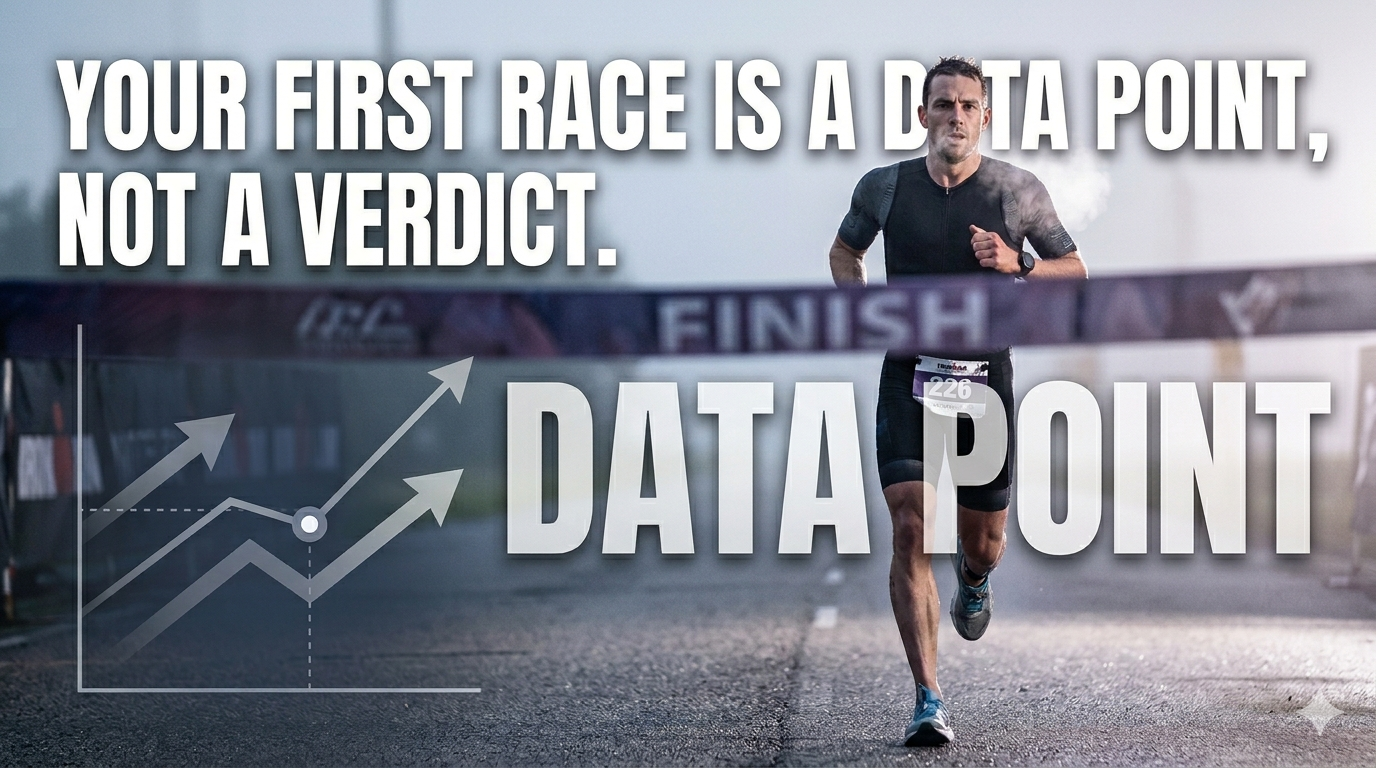
Your first race of the season is a data point, not a verdict
The alarm goes off at 4:30 a.m. You're wide awake before it even finishes. There's that familiar mix of nerves and quiet excitement — coffee, kit bag, transition bag, the mental checklist that's been running in the background since Tuesday. Race day has arrived.
For a lot of triathletes, the first race of the season carries more weight than it probably should. Months of training, early mornings, and skipped social plans have all pointed to this moment. So when the gun goes off, the pressure can feel enormous.
Here's what I want you to hold onto before you clip in, before you hit the water, before you do any of it: this race is a data point. It is not a verdict on your fitness, your dedication, or your potential. It is a field report — an honest look at where you are right now, in race conditions, on this particular day.
Race fitness and training fitness are two different things. The first race of the season is where you start closing the gap between them.
Setting the right expectations
Training and racing are genuinely different experiences. In training, you control almost everything — the route, the conditions, your warm-up routine, the music in your ears. On race morning, most of that goes out the window. There's the chaos of a crowded transition area, the cold shock of an open water swim start, the energy of the crowd pulling you out too hard in the first mile.
Even the most prepared athletes feel some rust in their first race back. That's not a failure of preparation — it's a completely normal part of the season. The body and mind need to relearn what racing feels like, separate from what a hard training day feels like. Those are not the same thing.
What this means practically is that your first result of the year is almost never your best result. It's a baseline. A starting point. And honestly, a well-read baseline is one of the most useful things you can have heading into the rest of the season.
Give yourself permission to be imperfect. The athletes who make the most of a full season are the ones who use early races as information, not judgment.
Before the race: keep it simple
The week before your first race is not the time for heroics. Whatever your training plan calls for, the key word in race week is restraint. A few easy sessions to keep the legs awake, good sleep, and boring, familiar food. This is not the week to try the new recovery drink or eat at an unfamiliar restaurant the night before.
A few things that matter more than athletes usually expect:
Know your course. Drive the bike route if you can, or at minimum study it on a map. Know where the hills are, where the turns are, and where the run is going to get hard. Surprises cost time and energy.
Set a process goal, not just a time goal. Going in with "I want to execute a controlled bike and run the first mile conservative" is going to serve you better than "I want to go sub-2:30." The process is what you can control. The outcome will take care of itself.
Performance goals focus on what you do. Outcome goals focus on what you get.
You control one of those completely. On race day, commit to the performance. "I will execute a smart bike split" is something you can own from the moment the gun goes off. "I will finish in under X hours" is a result that depends on your fitness, the course, the conditions, and a hundred things you can't manage in the moment. Race the performance goal. Let the outcome show up on its own.
Set up your transition twice. Walk through the swim-to-bike and bike-to-run in your head the night before. Many minutes are lost in transition simply because the athlete was surprised by something they could have thought through in advance.
Check your equipment — actually check it. Tires, nutrition on the bike, race belt, timing chip. Race morning is not the time to discover that your rear tire was slow-leaking in the garage all week.
The best race-day mindset I've seen in 20+ years of coaching: calm, focused, and a little boring. The athletes who arrive relaxed and execute their plan are the ones who finish satisfied — regardless of the clock.
After the race: read it, don't judge it
The hour after you cross the finish line is not the time for analysis. Eat something, rehydrate, celebrate finishing. Whatever happened out there, you showed up, you put yourself on the line, and that matters.
Once you've had a day or so to let the adrenaline settle, that's when the useful reflection begins. And the useful questions are rarely about your finishing time. They're more like:
How was the swim start? Did you go out too hard and spend the back half just hanging on? Or did you find a rhythm and build into it?
What happened on the bike? Did you pace it well, or did you ride too hard and feel the consequence on the run? Were you comfortable or fighting the whole way?
How did the run feel compared to the bike? The run-off-the-bike is its own skill, and the first race tells you a lot about where your threshold is for holding run form after a hard effort.
What would you do differently — specifically? Not "train harder." Something concrete, like start ten seconds per 100 slower on the swim, or cap effort on the first two miles of the run.
Write those observations down. Not in a spreadsheet, not in a training log full of numbers — just a few honest sentences while the race is still fresh. Those notes are worth more than the splits.
How a coach changes the equation
If you're self-coached, the challenge isn't effort — it's context. You can see what happened in a race, but it's much harder to know why, and harder still to know what to do about it. That's where working with a coach changes the experience, even if it's just for a single consultation.
Before race day, a coach is looking at your specific preparation — not a generic plan, but your training history, your fitness data, your tendencies under pressure. A good race brief tells you your targets for each discipline based on where your fitness actually is, not where you hope it is. That distinction matters enormously when you're standing on a start line trying to decide how hard to push.
After the race, a coach is reading the same data you are but with a different frame. A higher heart rate in the final run miles might mean you went out too hard. Or it might mean you're aerobically strong and just need to build the run volume to hold that pace longer. Those two interpretations point to completely different training prescriptions. The number alone doesn't tell you which one applies.
Across the season, a coach is managing the arc — building fitness through the early races, protecting you from accumulated fatigue as the schedule gets dense, and sharpening the approach as the A-race gets close. It's the difference between racing a season and racing every individual event in isolation.
Most athletes train hard. Few train right. The gap between those two things is almost always found in how well the training connects to the race — and that's precisely where coaching lives.
Whatever your first race of 2026 looked like — a clean execution, a messy day, or somewhere in between — you've got information now that you didn't have before. Use it. The season is long and the best races are still ahead.
Train with purpose,
Coach Ted
Catalyst Endurance Coaching
Data Focused/Athlete Driven
Work with Catalyst Endurance
Ready to make your first race work for you, not against you?
Your early-season race is full of useful information. A coach knows how to read it — and how to connect what happened out there to a training plan that gets you where you actually want to go. Whether you want a single consultation or full One on One Coaching, let's start the conversation.