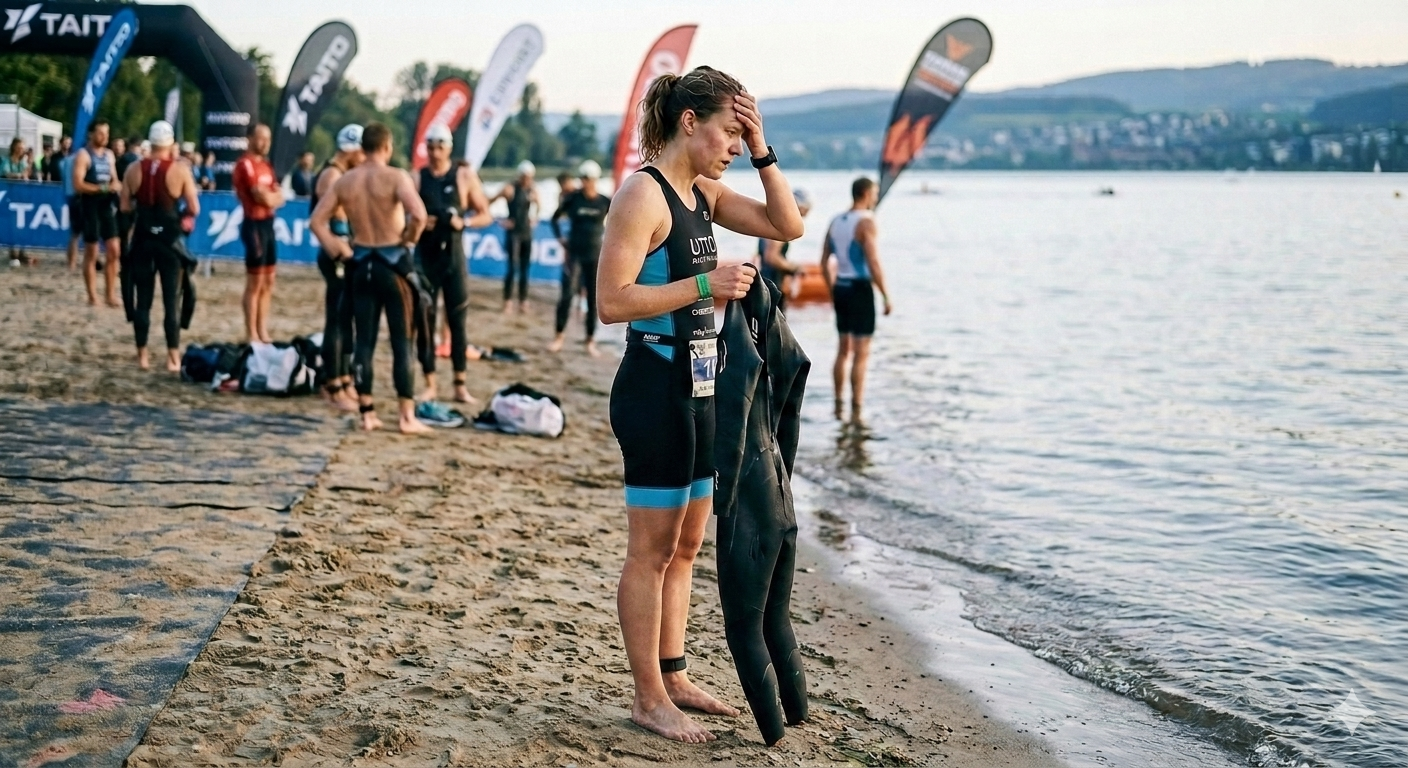
How to stop pre-race anxiety from sabotaging the work you have already done
Race season is here. For many athletes — first-timers and veterans alike — that means something else arrives right along with the taper: anxiety. The sleepless nights. The second-guessing. The quiet voice asking, "What if I'm not ready?"
Here is what that voice gets wrong: the fact that you feel it at all is evidence you care, and caring is part of what got you through training. Pre-race anxiety is not a warning sign. Managed correctly, it is a performance signal.
This post breaks down what is actually happening physiologically, why the nerves are normal, and — more importantly — what you can do in the days and hours before a race to keep anxiety working for you instead of against you.
What the science says about pre-race anxiety
Competitive anxiety in endurance athletes operates on two tracks simultaneously: cognitive anxiety (the mental worry loop) and somatic anxiety (the physical symptoms — elevated heart rate, GI distress, muscle tension). Research from the Wisconsin Psychiatric Institute and elsewhere documents that GI disturbances — cramping, nausea, urgency — are common around competition and are directly tied to competitive performance anxiety in endurance athletes. You are not imagining it, and you are not alone in it.
The Yerkes-Dodson law describes an inverted U-shaped relationship between arousal and performance. Very low arousal means you are flat, under-motivated, and disengaged. Very high arousal overwhelms working memory, consumes cognitive resources, and disrupts pacing execution. The sweet spot — moderate, controlled arousal — is where performances are built.
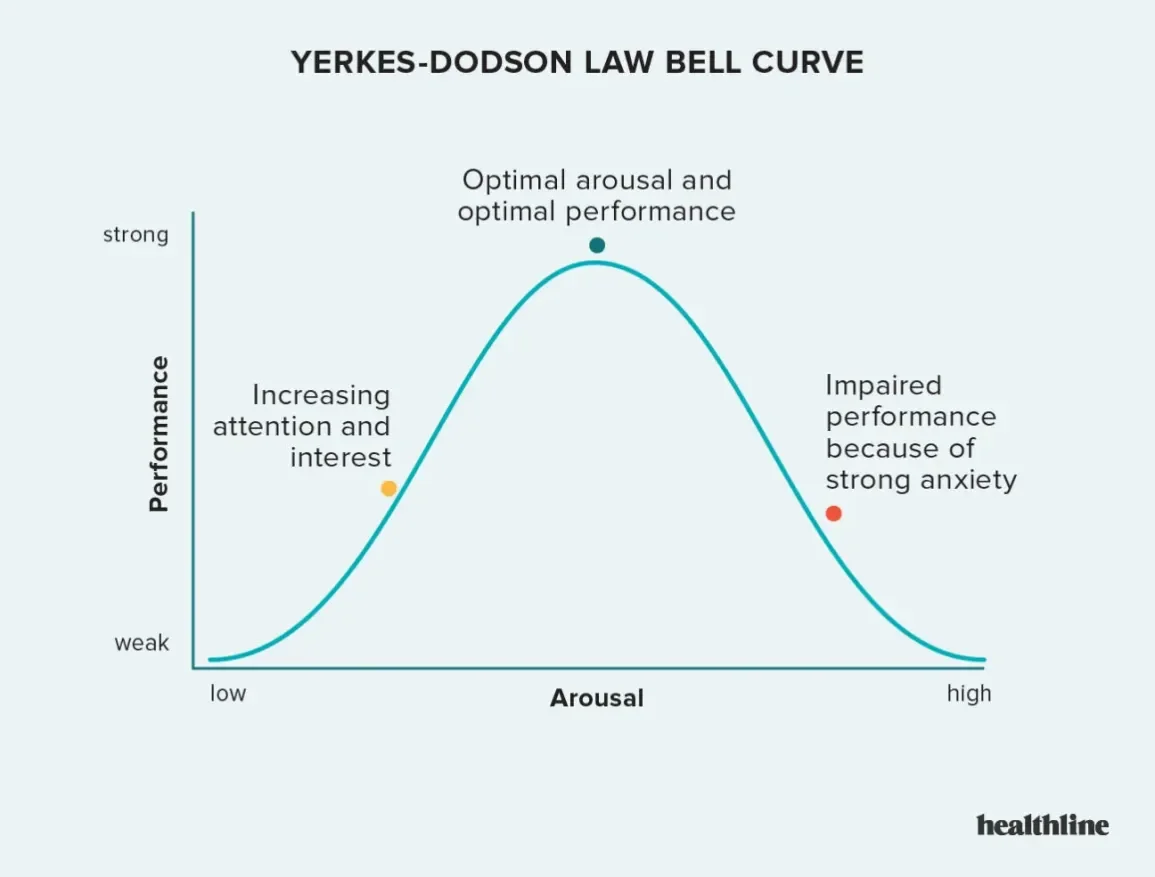
Raglin and Hanin’s research found that unmanaged anxiety-related performance decrements in athletes can be equivalent to arriving at the start line 10–15% undertrained.
The fitness is there. The anxiety is the variable.
Recent research published in BMC Sports Science (2024) studying recreational Ironman and endurance athletes found that emotional state before and during a race is both physically and mentally consequential — and that athletes who approach it with a holistic framework perform better and recover better afterward.
Why anxiety spikes — and why that is normal
In endurance sport, the stakes of a single event are unusually concentrated. A soccer player who has a rough game can line up again next week. You have spent months — sometimes years — building toward a single morning. That weight is real, and it is one reason pre-race nerves hit harder than most people expect.
Your brain registers the race as a high-consequence event and triggers a threat response. Cortisol rises. Sympathetic nervous system activity increases. From an evolutionary standpoint, this is the same circuitry that prepared your ancestors to either fight or run — and right now, you actually are about to run. Or swim. Or ride. The arousal is appropriate. The interpretation is everything.
Research from Harvard Business School on cognitive reappraisal found something important: anxiety and excitement are physiologically nearly identical states. Both involve elevated heart rate, heightened attention, and increased arousal. The difference is the label you assign them. Studies showed that athletes who reframed the pre-competition anxiety state as excitement — rather than trying to suppress it or calm down — performed measurably better. The shift is subtle: from "I am nervous" to "I am ready."
A 2025 study in Frontiers in Psychology further confirmed that how athletes interpret their emotional state before competition matters as much as the intensity of that state. Athletes in what researchers called a "Facilitating Arousal Profile" — those who viewed their pre-race emotions as performance-enhancing rather than threatening — reported greater perceived control and used more adaptive coping strategies.
Trust the training log, not the taper brain
Taper week has a well-documented psychological effect on athletes. Reduced volume, accumulated fatigue clearing, and the proximity of race day combine to produce a pattern coaches see constantly: suddenly everything feels off. Legs feel heavy or too light. Sleep is disrupted. Minor tightness becomes a potential catastrophe. Athletes who have trained consistently for sixteen weeks begin questioning whether they have trained at all.
This is taper madness. It is not data.
Your TrainingPeaks numbers do not lie. Your CTL, your threshold sessions, your long-course simulations — that record is the truth of your preparation.
Taper brain is not data. The work is in the log.
When anxiety tells you that you are not ready, go back to the evidence. What does your training load history actually show? What did your last long brick tell you about your capacity? What did your threshold intervals look like three weeks ago? Data-driven athletes have an advantage here — they can fact-check the anxiety against the file.
If you do not have that file built yet, that is a separate conversation. The point for now: if the work is in the log, the work is in the legs. The race will find it.
Practical applications: race week and race morning
Managing pre-race anxiety is a skill. Like pacing or nutrition execution, it improves with deliberate practice and a defined protocol. Here is what the evidence supports — and what works in practice with competitive age-group athletes.
Race week
• Protect your sleep routine. Disrupted sleep is both a symptom and an amplifier of pre-race anxiety. Maintain your normal bedtime. Keep the room cool and dark. If race travel puts you in a different time zone, begin adjusting 3–4 days out. One poor night of sleep will not compromise your race — but chasing sleep and failing compounds the anxiety.
• Limit the forecast obsession. Checking race-day weather every two hours is not preparation — it is a way to manufacture new problems. Check once in the morning, note what you need to know (temperature range, wind, precipitation probability), adjust your pacing and nutrition plan accordingly, and close the tab.
• Write down your race plan and read it twice. A written execution plan shifts your mental focus from outcomes ("What if I blow up?") to process ("At mile 4 of the run, I hold Zone 3 regardless of feel"). Outcome anxiety is diffuse and hard to address. Process focus is actionable. Athletes who race on a documented plan make better decisions under fatigue.
• Reduce decision load. Lay out your gear. Pack your transition bag. Confirm your nutrition protocol. Every open decision point is a potential anxiety anchor. Close them all before race morning so the morning itself is execution, not planning.
• Limit the race-result conversation. Well-meaning training partners, family members, and athletes you follow on Strava can fill your head with comparative anxiety in race week. You are not racing their expectations. You are executing your plan against your preparation.
Race morning
• Arrive with margin. Rushing to transition is one of the most reliable ways to spike anxiety above its useful threshold. Build in 20–30 minutes of buffer beyond what you think you need. The transition setup itself is calming — it is a familiar ritual that puts you in execution mode.
• Box breathing at the start line. Four counts in through the nose, four count hold, four counts out through the mouth. Repeat 4–6 cycles. This activates the parasympathetic nervous system and reduces cortisol without suppressing the arousal you actually want. It is physiologically real and takes under three minutes.
• Use the warm-up intentionally. A race-specific warm-up is not just physical preparation — it is psychological confirmation. Moving through your disciplines at race-adjacent intensity tells your nervous system: this is familiar, I have done this, I know what this feels like. Do not skip it because you are nervous. The nerves are the reason to do it.
• Reframe the internal monologue. Instead of "I hope I don't blow up on the run," the cue becomes "My run is built on X weeks of durability work and I will execute my pacing plan." The anxiety is not gone — it is redirected into evidence and process. That is the shift.
• One word or one phrase. Many elite athletes use a single activation cue at the start — a word, a phrase, a physical trigger — that serves as a mental anchor. "Controlled." "Process." "Earned." It does not have to be motivational in the Instagram sense. It just has to put you in the right execution headspace.
When anxiety becomes something more
Pre-race nerves exist on a spectrum. What this post describes is performance anxiety — the normal, near-universal experience of elevated arousal before a high-stakes event. That is different from generalized anxiety disorder or chronic anxiety that persists well outside of competitive contexts.
Research in Frontiers in Psychology (2025) found that anxiety and sleep disorders are meaningfully present in endurance athletes, with approximately 12–13% of runners in some populations meeting criteria for clinical anxiety. If your anxiety is not contained to race week — if it is disrupting your training, your sleep across the entire season, or your daily functioning — that warrants a different level of support. Race-week protocols are tools for performance management. They are not a substitute for clinical care.
For athletes who find that anxiety runs deeper than pre-race nerves, working with a sports performance psychotherapist is not a sign of weakness — it is a coaching decision. The mental side of endurance performance is a trainable system, just like your aerobic base or your threshold power. It deserves the same professional attention.
One professional I trust and refer athletes to is Dr. Danny Isaacs, a psychoanalytic psychotherapist who specializes in sports and performance. Danny brings more than a decade of clinical experience to his work, having trained at the Tavistock and Portman Clinic in London, where he continues as a Senior Psychotherapist. His athlete credentials are equally serious — he has represented Great Britain at the Ironman World Championships in Kona and at the 70.3 World Championships and holds multiple national age-group podiums. He understands this world from both sides of the equation.
Danny works with professional and amateur triathletes, runners, and other competitive athletes on the psychological and emotional barriers that prevent them from performing at the level their training warrants. If what you are experiencing goes beyond the protocols in this post, I would encourage you to reach out to him directly.
Coach’s Referral
Dr. Danny Isaacs
Sports & Performance Psychotherapist | Mind Equals Matter
Psychoanalytic psychotherapist trained at the Tavistock and Portman Clinic in London, with more than a decade of experience working with competitive athletes. GB Age Group representative at the Ironman World Championships, Kona. Danny works with triathletes and runners on the psychological and emotional barriers between training and performance.
drdannyisaacs.com ↗ @drdannyisaacsThe bottom line
You built this fitness over months of deliberate work. The anxiety you feel before a race does not erase that — it reflects it. Your nervous system knows something important is coming. Your job is to direct that energy into execution.
The athletes who race best on race day are rarely the least anxious. They are the ones who have built a protocol, trust their preparation, and know how to redirect arousal into focus rather than letting it drain into worry.
The work is in the log. Now execute the plan.
Train smarter, race faster.
Still carrying more anxiety than your training warrants?
If race-day nerves are consistently costing you performance, it may be time to look at what is driving them. A Coach Consultation is a focused conversation about where you are, what is getting in the way, and what a structured approach would look like for your season.
Book a Coach Consultation →Coach Ted Geddis, USAT Elite Level 3 · Catalyst Endurance Coaching · catalystendurance.com