Most of us can ride a bike. Few of us actually drive one.
That distinction shows up on race day whether you notice it or not. Two athletes with identical fitness can post meaningfully different bike splits — and the gap isn't always fitness. It's how efficiently they ride the bike they're already on. The difference in total drag package (aerodynamics plus rolling resistance) between a fast professional bike split and a slower one can run 55–75 watts — enough to explain 15 to 17 minutes over an Ironman-distance bike leg. That gap is trainable. Handling, body position, and pacing discipline all move it, separate from any gain in raw fitness.
Four costs on every ride
Every watt you produce on the bike fights four sources of resistance: tire rolling resistance (2–5%, constant), drivetrain resistance (1–4%, constant), weight (2–5%, variable, mostly on climbs), and wind resistance — variable, and by far the largest. Above roughly 25 km/h, aerodynamic drag becomes the majority of the total resistance you're fighting. Line choice and body position move the biggest cost on that list, and neither one costs a dollar.
Braking: modulate, don't grab
Effective braking is a safety skill and a speed skill. Poor technique leads to skidding, instability, and lost time recovering from a bad line into a corner. The front brake carries the large majority of a bike's stopping power — the instant you brake, weight transfers forward, loading the front tire with the traction the rear wheel is losing. That's why smooth, modulated pressure on both brakes, weighted toward the front, stops you faster and safer than grabbing the rear.
The bigger technical error is timing, not force. Brake before entering a corner, not while you're in it — set your speed on the approach, then release and let the bike roll through the turn. Practicing this on a closed course (a stop-and-go drill, controlled emergency stops) builds the reflex before you need it in a race. Conditions change the plan: brake earlier and more gently on wet roads, alternate light pressure on descents, and favor the rear brake on gravel or loose surfaces to avoid fishtailing.
Cornering: entry, apex, exit
Cornering technique is really a line problem wearing a bike-handling costume. Enter wide, hit the apex — the tightest part of the turn — and exit wide to maximize your line and carry more speed through the corner than a straight-line approach allows. Your eyes matter as much as your hands: look through the turn toward where you want to go, not at the obstacle you're avoiding, and the bike tends to follow.
Body position finishes the job. Drop your outside pedal to the 6 o'clock position to lower your center of gravity, weight the outside pedal and inside handlebar for traction and balance, and lean the bike rather than your body for a sharper, more controlled turn. All braking happens before the corner — never mid-turn — with a slight bias toward the front brake.
Descending: relax, look ahead, commit
Descending rewards the same principles as cornering, at higher stakes. Relax your arms, shoulders, and upper body so the bike can absorb the road instead of fighting it. Keep your eyes on your line, not your front wheel, and once you pick that line, commit to it. Shift your weight back slightly on steep sections for stability, level your feet at 9 and 3, and feather the brakes with light, consistent pressure rather than sudden or harsh grabbing — the front does most of the work, the rear fine-tunes.
Confidence here is built, not assumed. Start on small hills you know well and progress gradually to steeper, longer, faster descents, rather than testing your limits for the first time on race-morning terrain you've never seen.
The aero position: where the free speed actually lives
Riding in the aerobars is the discipline most triathletes under-practice relative to how much time it actually costs or saves them. Wind-tunnel and computational research on cyclist positioning has found that a rider's own body — not the bike — accounts for roughly 60 to 70 percent of total aerodynamic drag, which makes position the single largest lever available above race-relevant speeds, ahead of any equipment upgrade (Defraeye et al., 2010).
A properly executed tri-specific bike fit typically reduces CdA (drag area) by 0.03 to 0.06 square meters, worth roughly 8 to 20 watts of drag saved at 25mph/40 km/h — call it a minute and a half to four minutes over a 56mile/90kilometer bike leg, along with 2 to 4 percent more usable seated power from better hip and knee alignment. Few single training blocks return that much.
The position only pays off if you can hold it. Build it in a controlled environment first — a trainer or empty lot — with a relaxed grip that lets the elbows carry the weight instead of the hands, a compact and flat back, a neutral neck, and an engaged core. Steer with small, subtle inputs; aggressive bar movement destabilizes the bike at speed. In crosswinds, lean slightly into the wind with a touch more weight forward, and transition smoothly to the base bars whenever a corner or technical section calls for more control.
Group and draft-legal riding
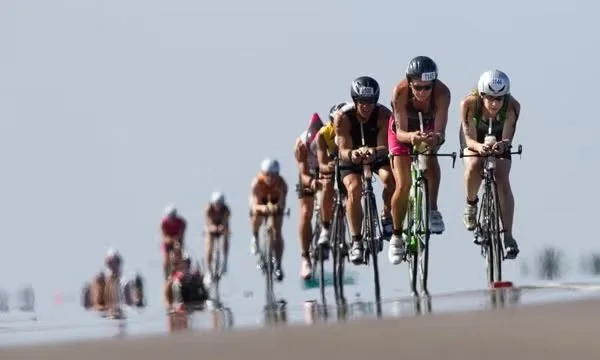
Riding well in a group is a distinct skill from riding fast alone, and it matters even outside draft-legal racing — pack dynamics on training rides and in mass-start events reward the same habits. Drafting reduces the oxygen cost of cycling meaningfully: one controlled study found a 14 percent reduction in oxygen uptake and a 7.5 percent reduction in heart rate when cycling in a sheltered position behind a lead rider, compared to riding alone at the same speed (Hausswirth et al., 1999). That efficiency is only available to riders who can hold a predictable line.
The habits that make group riding safe are simple and non-negotiable: maintain a consistent speed, hold a straight and predictable line, keep your upper body relaxed enough to absorb small bumps without overcorrecting, and never overlap wheels with the rider ahead. Communicate constantly — verbal cues for slowing or hazards, hand signals for turns — and scan past the wheel directly in front of you to the riders further up the group. Most group-riding incidents trace back to a short list of habits: overlapping wheels, tunnel vision on the wheel ahead, erratic pace changes, or simply not communicating.
Managing variability: protect the run before you get off the bike
The clearest evidence for why bike handling and pacing discipline matter to triathletes specifically shows up not on the bike split, but in the run that follows it. A controlled study measuring the effect of cycling pacing on a subsequent 5K found runners were significantly faster after a constant-intensity 20-kilometer cycling bout than after variable-intensity or freely chosen pacing — a meaningful gap from pacing discipline alone, with no change in total work performed on the bike (Bernard et al., 2007).
A broader review of pacing research in triathlon reaches the same conclusion from a different angle: an even cycling pacing strategy consistently outperforms a variable one for subsequent running performance, even though race dynamics and terrain often push athletes toward large swings in effort (Wu et al., 2014).
That's the case for tracking Variability Index (VI) — normalized power divided by average power — and keeping it close to 1.0. A low VI means smoother, more consistent effort, which conserves the muscular and metabolic reserves you'll need for the run. In practice: cap your effort by wattage or perceived exertion on hills instead of surging, use smooth gear changes to hold cadence, watch a smoothed power reading rather than reacting to every spike, and trust your race plan over the temptation to match a competitor's move.
Train with purpose
None of these skills require new equipment. They require repetition — in a parking lot, on a familiar hill, in the aero bars on a trainer — until braking before the turn, weighting the outside pedal, and holding a steady watt number become automatic instead of effortful. That's the difference between riding the bike you have and racing it.
References
Bernard, T., Vercruyssen, F., Mazure, C., Gorce, P., Hausswirth, C., & Brisswalter, J. (2007). Constant versus variable-intensity during cycling: effects on subsequent running performance. European Journal of Applied Physiology, 99(2), 103–111.
Defraeye, T., Blocken, B., Koninckx, E., Hespel, P., & Carmeliet, J. (2010). Aerodynamic study of different cyclist positions: CFD analysis and full-scale wind-tunnel tests. Journal of Biomechanics, 43(7), 1262–1268.
Hausswirth, C., Lehénaff, D., Dréano, P., & Savonen, K. (1999). Effects of cycling alone or in a sheltered position on subsequent running performance during a triathlon. Medicine & Science in Sports & Exercise, 31(4), 599–604.
Wu, S. S. X., Peiffer, J. J., Brisswalter, J., Nosaka, K., & Abbiss, C. R. (2014). Factors influencing pacing in triathlon. Open Access Journal of Sports Medicine, 5, 223–234.