Open Water Swimming: The Skills That Actually Decide Your Swim
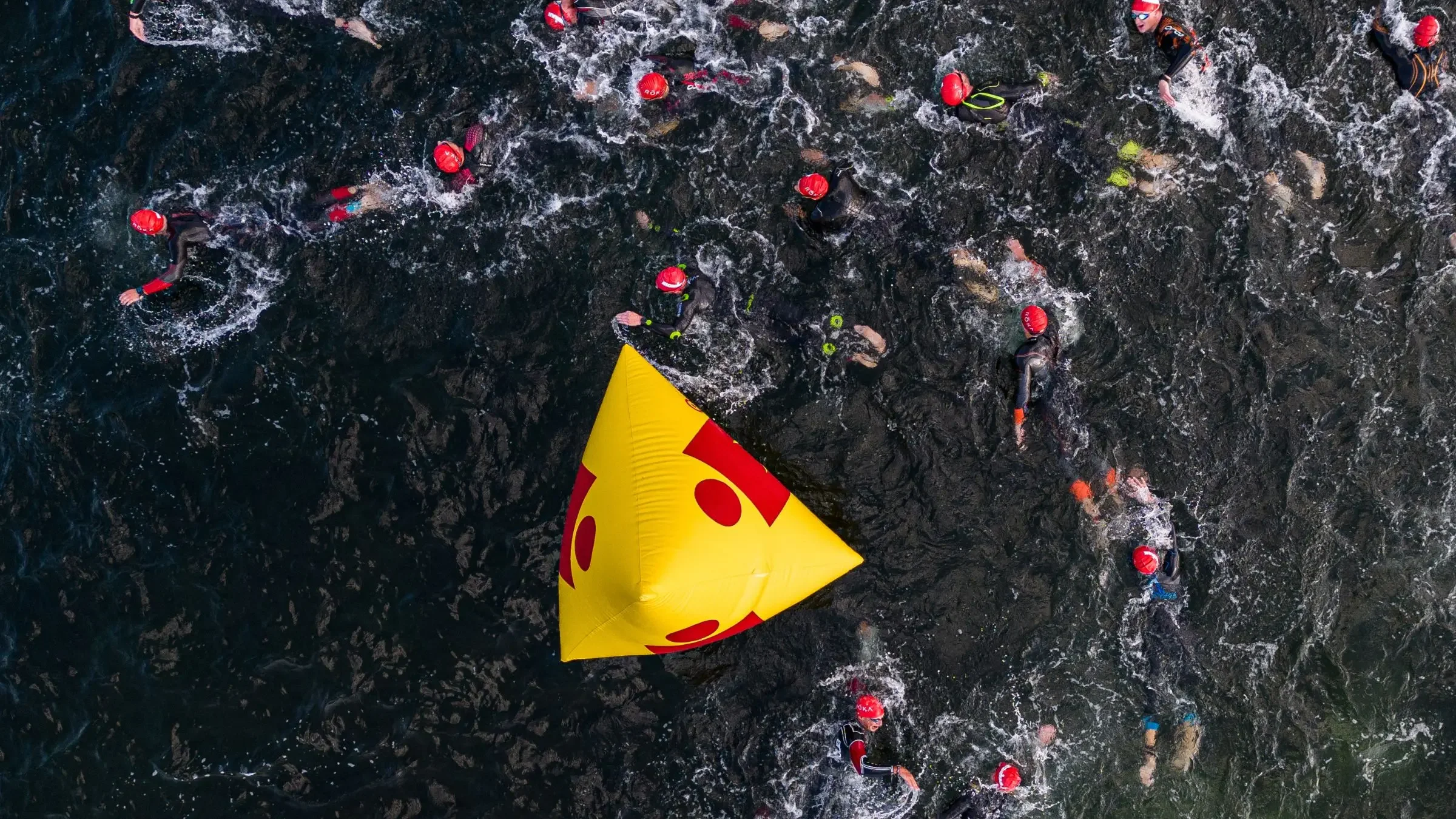
The pool has walls, lane lines, and a black line on the bottom telling you exactly where to go. Open water has none of that — and that gap is where most triathletes lose time on race morning, long before fitness becomes the limiter.
The good news: open-water swimming is a skill set, not a personality trait. Treading water without panic, sighting without breaking stroke, turning a buoy without losing your rhythm, and drafting without wasting the opportunity are all trainable — most of them in a pool, well before you ever need open water to practice in. This post covers the skills that matter most, from the first time you swim without a wall to riding another swimmer's draft for free speed.
Get comfortable without the walls
Three things are missing in open water: the walls, the lane lines, and the bottom of the pool. If you've never practiced resting without them, race morning is the wrong time to find out how that feels. For newbie swimmers or those with open water anxiety, like myself, a back float — face out of the water, breathing in through the mouth and out through the nose, hands sculling gently at the hips — gives you a way to pause without standing up. Treading water (an eggbeater or breaststroke kick paired with sculling arms) does the same thing in a vertical position when you need to see over chop or other swimmers.
Build the skill in the pool before you need it in open water: swim a continuous set roughly 25 percent longer than your race distance without touching a wall, standing on the bottom, or hanging on a lane line. Practice whatever rest stroke you'll actually use — back float, breaststroke, sidestroke — so it's automatic if you need it.
Sighting: the skill that keeps your swim from getting longer
Sighting is lifting your eyes just above the surface to check your line, without stopping the stroke to do it. Poor sighting doesn't just cost a glance — it costs distance, and distance compounds over a full race swim. The technique: as your lead hand enters the water, press slightly down to lift your eyes to goggle height, spot your target, then roll your head into your normal breath. Your whole face doesn't need to clear the water — just your eyes.
Practice this in the pool first. Pick a landmark — a water bottle, a coach, the flag on the wall — and sight for it every 6 to 10 strokes while swimming normal freestyle. Once it's automatic in a controlled setting, it holds up far better under the chop, glare, and crowding of an actual start.
Turning buoys without losing your rhythm
Every buoy on course is a disruption to your rhythm and a moment where a lot of swimmers converge on the same small piece of water at once. How you turn it depends on its size.
- Stay tight to the buoy, or go wide if there's traffic
- Keep your head up slightly, steering toward the buoy — like running the curve of a track
- Maintain a normal stroke through the turn
- Turning right: pull with the right arm across and under the body
- Recover and pull straight back with the left, arching slightly to circle the buoy
- Should take only a few strokes — otherwise use the wide-turn technique
Strategically, the goal is simple: get in and get out. Pick up your stroke rate and speed on the approach, and position yourself toward the front of the pack so you clear the turn with as little contact as possible. If you're newer to swimming in a crowd, it's fine to take the wider, clearer path around a buoy even if it costs a little extra distance — avoiding the washing-machine chaos at the tightest point is worth more than the few seconds you'd save cutting the corner.
Drafting: legal, free speed
Riding another swimmer's slipstream is banned on the bike but completely legal in the water, and the energy savings are real and measurable. Swimming directly behind another athlete's feet reduces the passive drag you're fighting; swimming at their hip does the same at a smaller magnitude, with the advantage of keeping your own sighting view open.
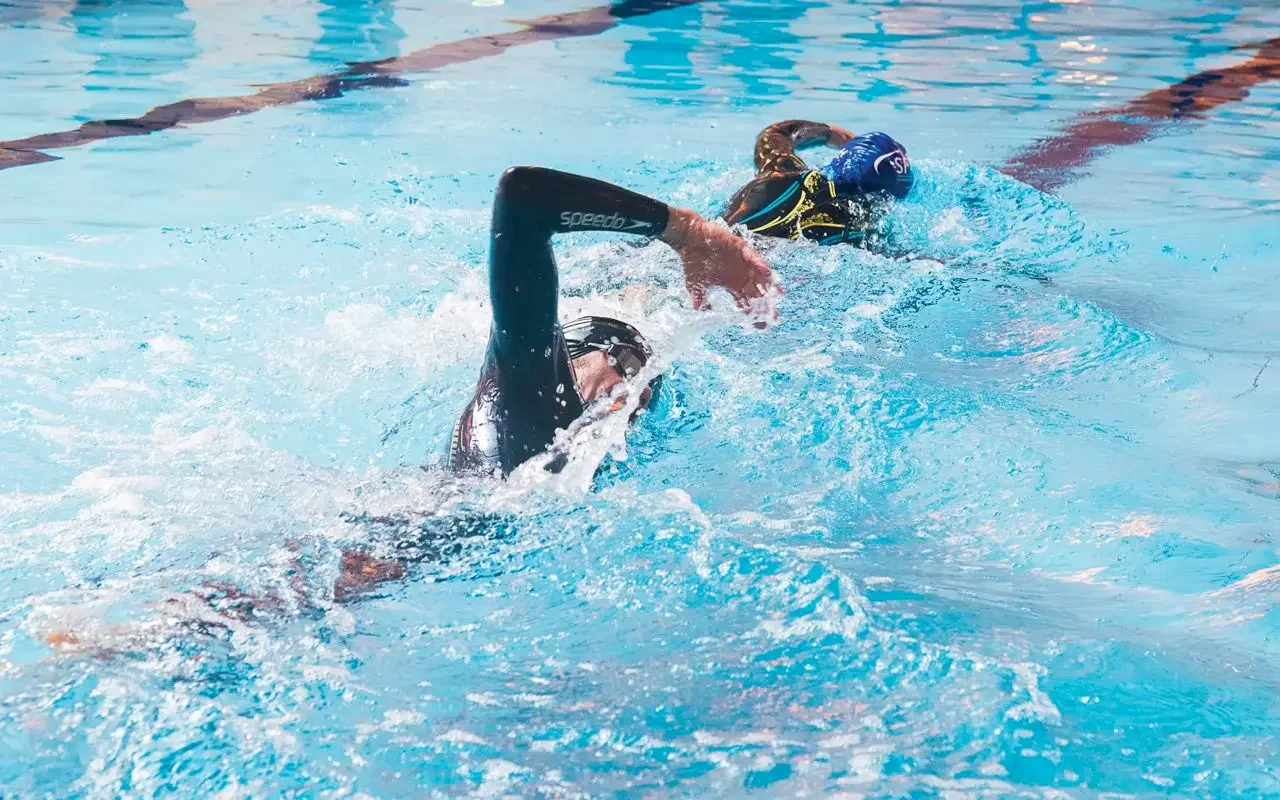
That drag reduction shows up physiologically, too: swimmers drafting behind a lead swimmer post measurably lower oxygen uptake and heart rate than swimming the same pace alone (Bassett et al., 1991) — meaning the same speed costs you less.
To use it: find a swimmer just slightly faster than your solo pace and stay with them. Position directly behind their feet, close enough that you feel their wash without your hands clipping their toes, and focus on following the line of their body (or their bubbles) rather than sighting the buoys yourself as often. Practice it in the pool with a training partner over a longer set — alternate leading and drafting every 100 so you feel both sides of the exchange.
Reading the water: stroke tempo for conditions
One stroke tempo doesn't serve every condition. Chop, wind, and waves interrupt your rhythm — catching an arm mid-recovery, filling your mouth mid-breath — and a shorter, faster stroke recovers from those interruptions quicker than a long, slow one. Calm water rewards the opposite: longer strokes at a slightly slower cadence are more efficient when nothing is knocking you off rhythm.
A simple way to find your own range: swim a set of 8×50 and score each one by adding your stroke count to your time in seconds — lower is better. Experiment with faster and slower cadences across the set and see where your personal number lands. That's your efficient range in calm water; expect it to shift shorter and faster the choppier things get.
Train it: a race-simulation set
Run this session in place of one normal swim most weeks in the six to eight weeks before your race. It's built to be sustainable, not a killer set — the point is repetition of the skill, not exhaustion.
Train with purpose
None of this requires open water to practice, and most of it doesn't require extra time — it requires intent inside the swim you were already going to do. Sight on your normal sets. Practice no-wall turns instead of pushing off. Find a partner to trade drafts with. By the time the gun goes off, the open water should feel like a change of scenery, not a change in skill set.
References
Bassett, D. R., Flohr, J., Duey, W. J., Howley, E. T., & Pein, R. L. (1991). Metabolic responses to drafting during front crawl swimming. Medicine & Science in Sports & Exercise, 23(6), 744–747.
Chatard, J.-C., & Wilson, B. (2003). Drafting distance in swimming. Medicine & Science in Sports & Exercise, 35(7), 1176–1181.
Wu, S. S. X., Peiffer, J. J., Brisswalter, J., Nosaka, K., & Abbiss, C. R. (2014). Factors influencing pacing in triathlon. Open Access Journal of Sports Medicine, 5, 223–234.