Heat Acclimation for Triathletes
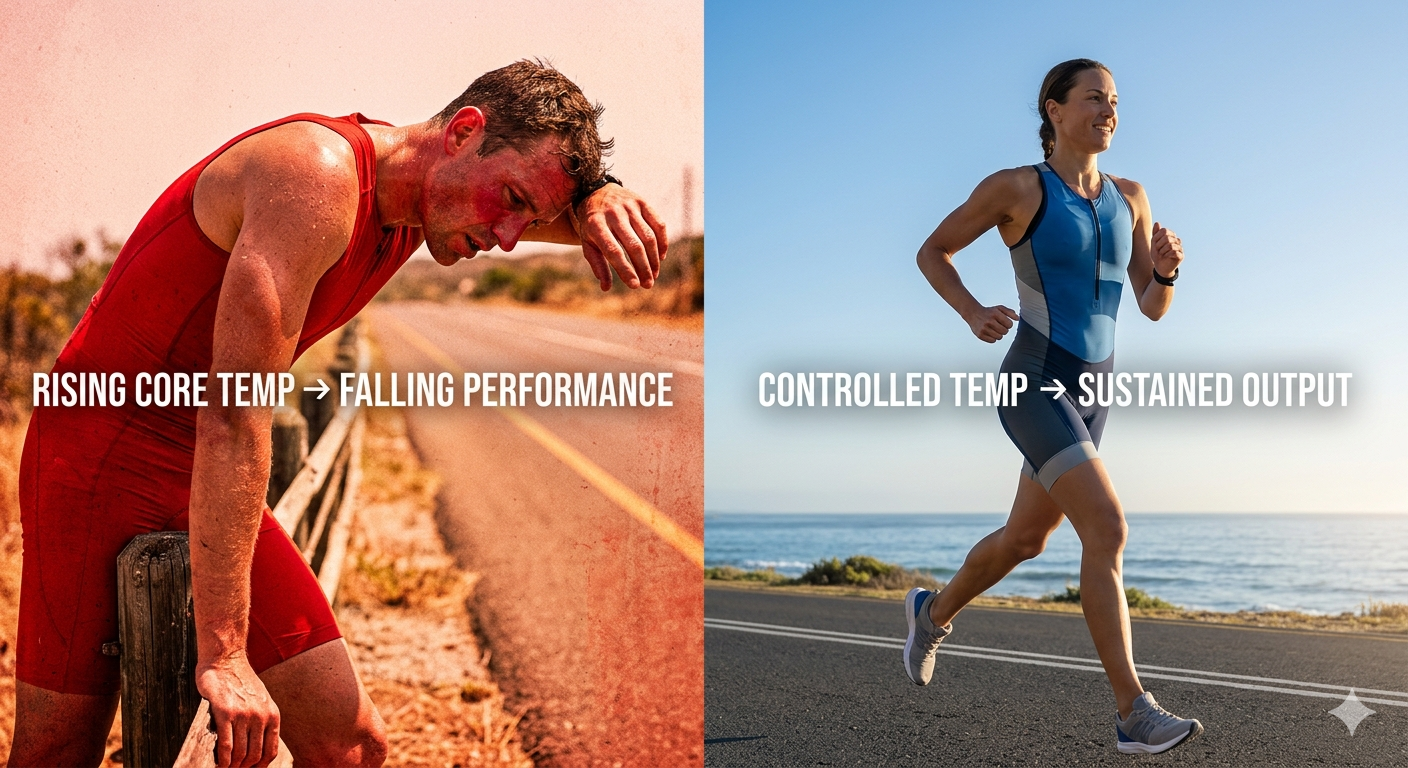
Your Competitive Advantage as Temperatures Rise
Why Heat Acclimation Matters
As winter fades and racing season approaches, one performance variable quietly dictates outcomes for triathletes who aren't ready for it: heat. Not fitness. Not equipment. Not even pacing. If your body hasn't learned to manage thermal strain, race-day heat will cap your performance regardless of how well-trained you are.
The good news is that heat tolerance is one of the most trainable physiological qualities in endurance sport. With a structured, progressive approach, meaningful gains are achievable in as little as 10 to 21 days. For age-group athletes balancing work, family, and training, that's a high-return investment -- and the barrier to entry is low. You don't need special equipment to start. A warm room, a set of extra layers, and a consistent schedule are enough to drive real physiological change.
The heat-adapted athlete produces more output for less physiological cost: lower heart rate, earlier sweating, reduced perceived effort, and a higher ceiling before performance degrades.
Heat acclimation drives a set of well-documented physiological adaptations. Plasma volume expands, meaning the cardiovascular system delivers oxygen more efficiently at a given intensity. Heart rate at a fixed workload drops. The sweating mechanism activates earlier and works more efficiently, dissipating heat before it accumulates. And most importantly for race day, core temperature during exercise is lower -- giving you more headroom before hitting your thermal limit.
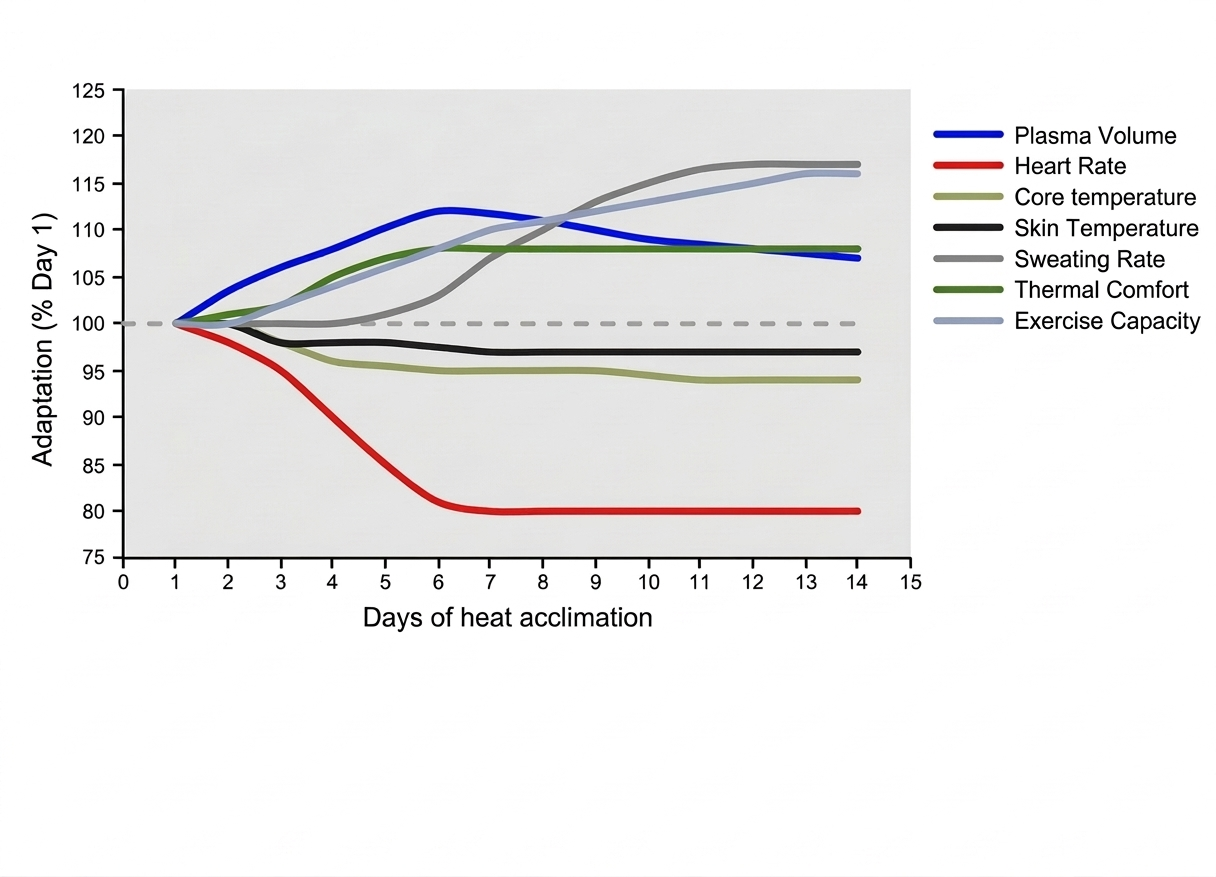
The methods available to drive these adaptations range from completely free to moderately priced, and from feel-based to precisely monitored. The following sections walk through the full spectrum, starting with the simplest and most accessible approaches and building toward more sophisticated tools for those who want to measure and prescribe thermal load with the same rigor they apply to power or pace.
Traditional Heat Acclimation Methods
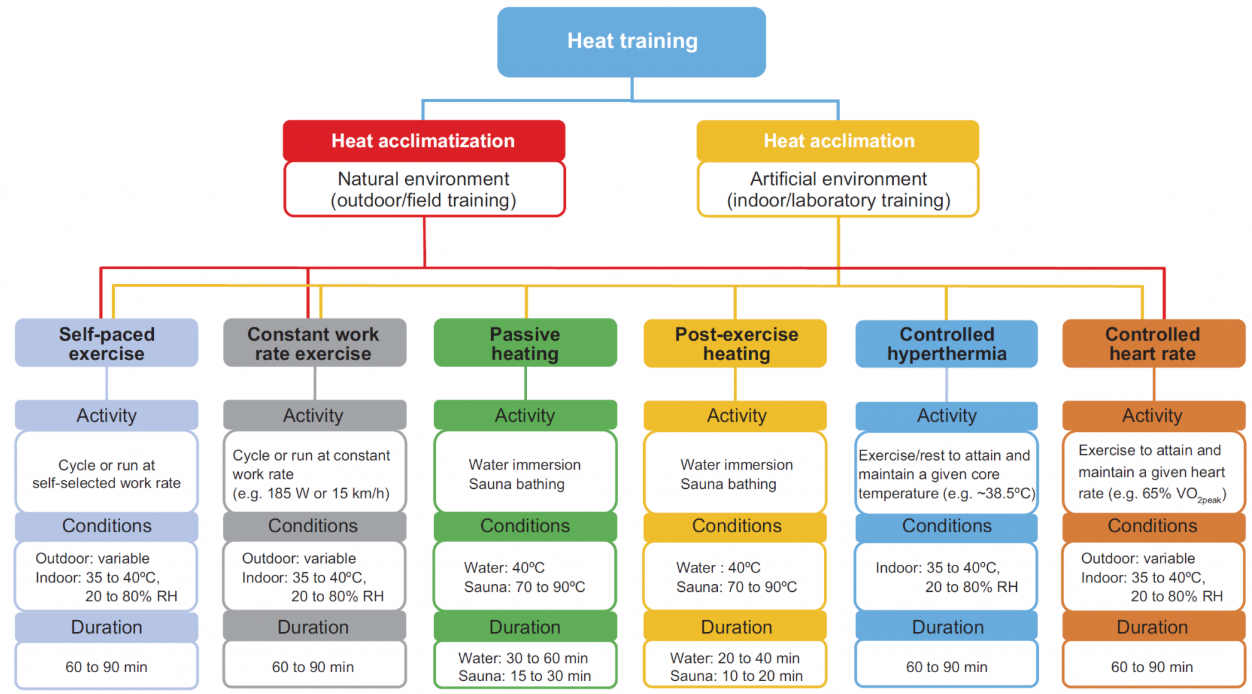
Before any technology enters the picture, athletes have been using environmental manipulation to build heat tolerance for decades. These approaches are accessible, free or near-free, and highly effective when applied consistently. The core principle is straightforward: create a warm training environment and train in it repeatedly over 10 to 21 days.
Training in a Hot Room
One of the most straightforward methods is simply moving indoor training sessions into a warmer space. Turn off the air conditioning, close the windows, and train at reduced intensity. A room temperature of 85 to 95 degrees F (29 to 35 degrees C) with moderate humidity is sufficient to drive meaningful adaptation in most athletes.
For cyclists, a closed garage or spare room with the fan off works well. Runners can use a treadmill in an un-air-conditioned space, or simply shift easy runs to midday outdoor sessions during the warmer months. The key is deliberately removing the cooling that normally blunts heat exposure: no fans, no cool breezes, no ice towels mid-session. The goal is 30 to 60 minutes at easy to moderate intensity -- not performing well in the heat, but accumulating repeated exposure so the body learns to manage it.
Layering and Heat Retention
A simple companion technique is training in extra layers to trap body heat. A long-sleeve base layer under a short-sleeve jersey, or running tights instead of shorts, slows the rate of heat dissipation so that core temperature rises to the productive zone more quickly and stays there longer -- at the same exercise intensity.
This is particularly useful for athletes in cooler climates or training through shoulder seasons. If you're preparing for a warm-weather race in late spring while still running through a cool April in New England, layering lets you replicate the thermal environment you will encounter on race day without waiting for the weather to cooperate.
One important boundary: layering belongs on easy and aerobic days only. Adding thermal stress on top of a high-intensity interval session or quality long run raises heat illness risk without proportional adaptation benefit. Stack heat on the easy days; protect the hard days.
Passive Heat Exposure: Sauna and Hot Bath
Passive heat exposure is one of the most time-efficient tools in the heat acclimation toolkit. It fits naturally into a post-workout recovery routine, adds no aerobic training load, and is well-supported by research as a standalone adaptation stimulus. The two most practical options are the sauna and the hot bath or whirlpool.
Dry or infrared sauna. A dry sauna at 80 to 100 degrees C (176 to 212 degrees F), or an infrared sauna at the lower end of that range, delivers a strong thermal stimulus in a short window. Fifteen to thirty minutes post-exercise, two to five times per week, is the evidence-supported dose. Infrared saunas are increasingly available at gyms and recovery studios, making them accessible without a home installation.
Hot bath or whirlpool. Hot water immersion at 40 to 42 degrees C (104 to 108 degrees F) for 20 to 30 minutes post-exercise is equally effective and often the most accessible option. A standard bathtub works just as well as a whirlpool. For athletes without sauna access, this is a fully legitimate substitute -- and just as evidence-backed.
In both cases, timing matters: post-exercise is the most potent stimulus because core temperature is already elevated and the body's adaptive signaling pathways are primed. One additional protocol step amplifies the effect significantly:
After passive heat exposure, delay rehydration for 10 to 20 minutes before drinking. This brief window reinforces the plasma volume expansion signal that drives adaptation. It is not dehydration training -- it is a targeted, short-duration stimulus. Resume full hydration intentionally after that window closes.
From Feel to Data: Monitoring Heat Stress
Athletes using the traditional methods above are working primarily by feel and heart rate -- and that is a completely valid approach. Perceived exertion, the timing of sweat onset, and resting heart rate trends across the training block all serve as useful proxies for how the body is adapting.
The clearest signal to track without any device: cardiac drift at a fixed power or pace output will be elevated in the early sessions and should progressively normalize as adaptation builds. If heart rate at a given effort is measurably lower in Week 3 than it was in Week 1, that is adaptation showing up in a number you already have. No additional equipment required.
For athletes who want to move beyond secondary signals and measure thermal strain directly, core body temperature monitoring is the next step. Rather than inferring how hot the body is getting, it measures the actual variable that limits performance in heat -- the temperature inside the body itself. This removes the guesswork from dosing heat exposure, and it gives coaches a precise tool to track adaptation week over week.
Advanced Monitoring: The CORE Body Temperature Sensor
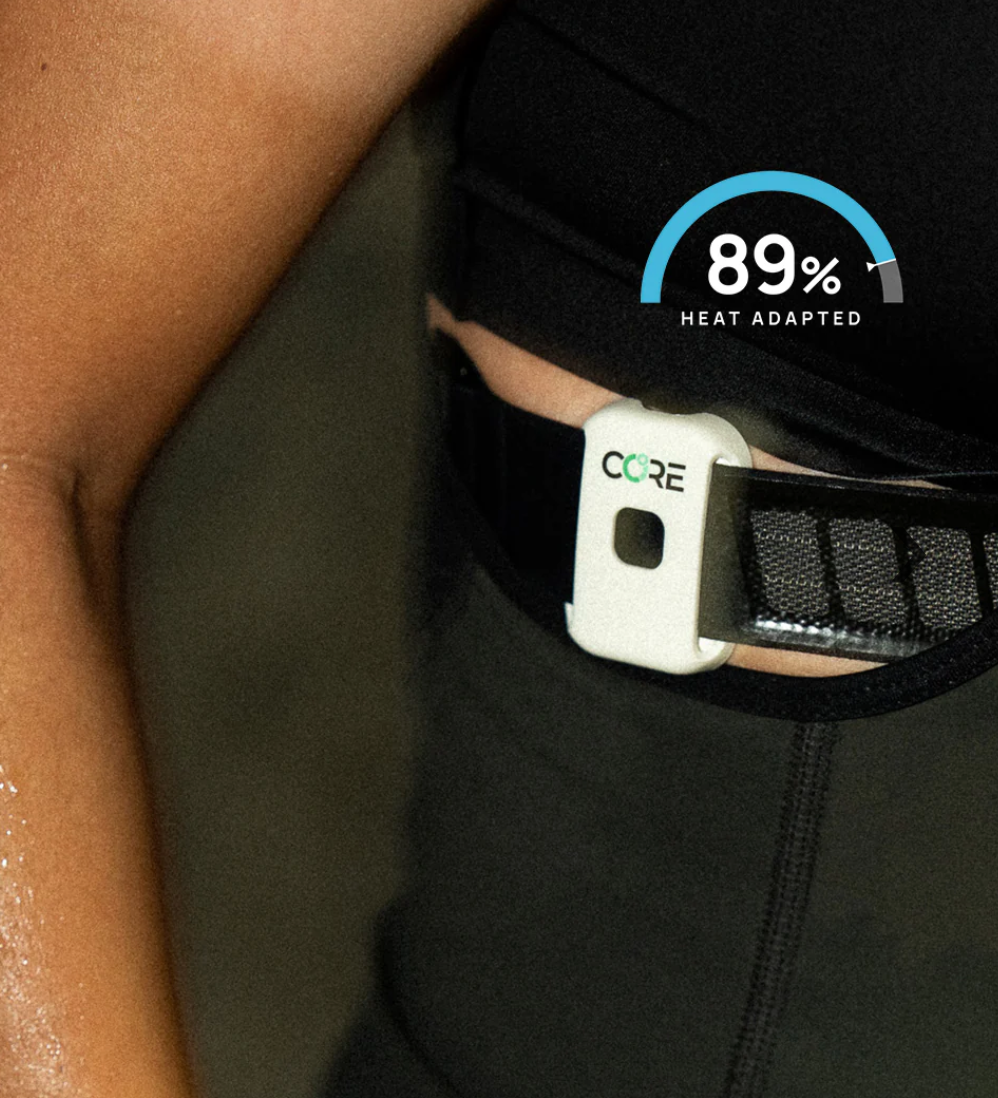
The CORE body temperature sensor is a compact wearable device that clips onto a heart rate chest strap and continuously estimates core body temperature during exercise. It uses heat flux combined with skin temperature data to calculate an internal temperature reading, streaming live to Garmin head units, Wahoo devices, and companion phone apps. No ingestible temperature pills, no lab setup -- just real-time data displayed alongside your other training fields.
Think of the three key training metrics this way: Power = mechanical output. Heart rate = cardiovascular strain. Core temperature = thermal strain. In hot conditions, thermal strain is the actual limiter -- and now you can measure it directly.
The practical value is this: instead of asking 'did I get hot enough today?', you know exactly where your core temperature was, for how long, and how that compares to last week's sessions. You can prescribe a heat session the same way you would prescribe a power-based interval -- with a target zone, a time-in-zone goal, and a measurable outcome.
How to Use Core Temperature in Training
Control the dose. Ride or run easy and watch core temperature rise on your Garmin watch or bike computer. Maintain the effort that brings you into the productive zone and holds you there. This prevents the common early-block mistake of overshooting before the body has built any tolerance -- a mistake that is easy to make by feel and hard to make when you're watching an actual number.
Extend time in zone. Rather than chasing watts or pace, shift the focus to time spent at elevated core temperature. Twenty to forty minutes in the 38.0 to 38.5 degree C range delivers a strong adaptive stimulus. As adaptation builds, you will notice it takes more effort to reach that zone at the same intensity -- which means the adaptation is working.
Track adaptation over time. Session by session, the measurable signatures of real adaptation appear: a slower temperature rise at a given workload, a lower peak temperature for the same effort, and faster post-session cooling. Those patterns show up in the data before they show up in race results, giving coaches a genuine leading indicator of readiness.
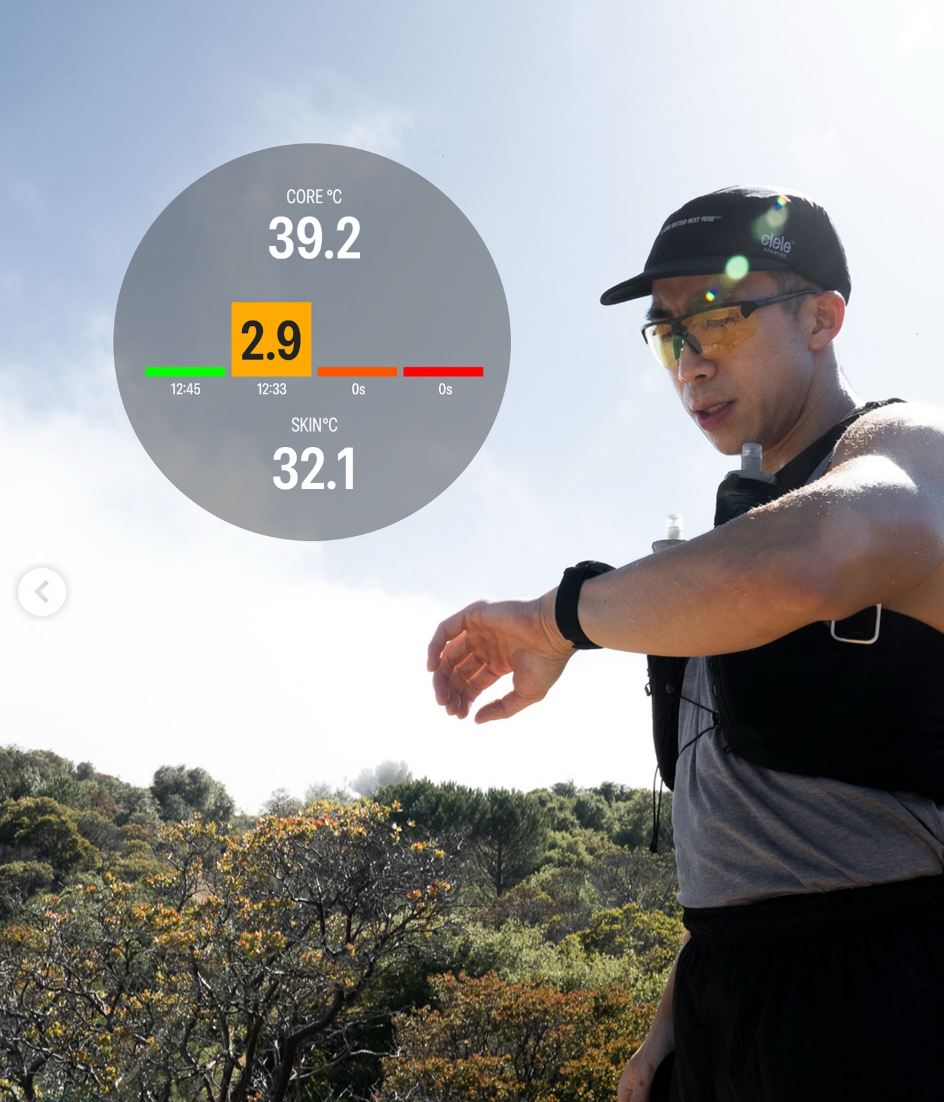
Heat Strain Index
CORE's Heat Strain Index measures how hard your thermoregulatory system is working to cool itself. Extensive research has shown that the concept of mean body temperature is one of the top indicators for assessing heat strain. Mean body temperature is the weighted average of the body’s core temperature and skin temperature.
Significance of Heat Strain
The human body aims to maintain core temperature within a narrow range (~36.0–37.5°C/ 96.8–99.5°F). This is achieved by balancing the body's heat production and heat loss. During exercise, the body's heat production rises. To balance this, the body activates its heat loss mechanisms.
It generates sweat for evaporative cooling of the skin, and it widens skin blood vessels and raises heart rate to increase blood flow to the skin. When cooling demands are high, the increased blood flow to the skin causes blood to be diverted away from the muscles.
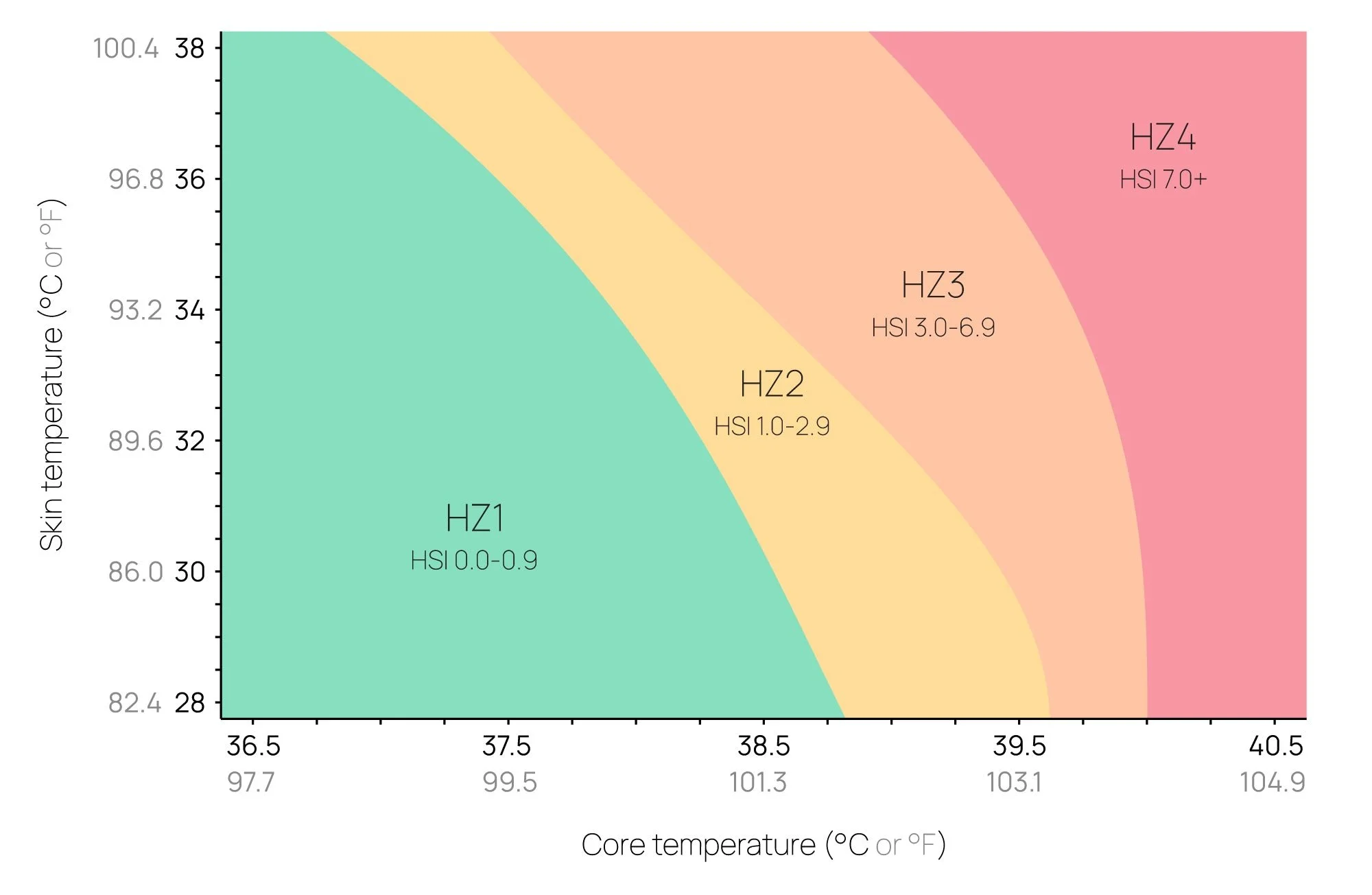
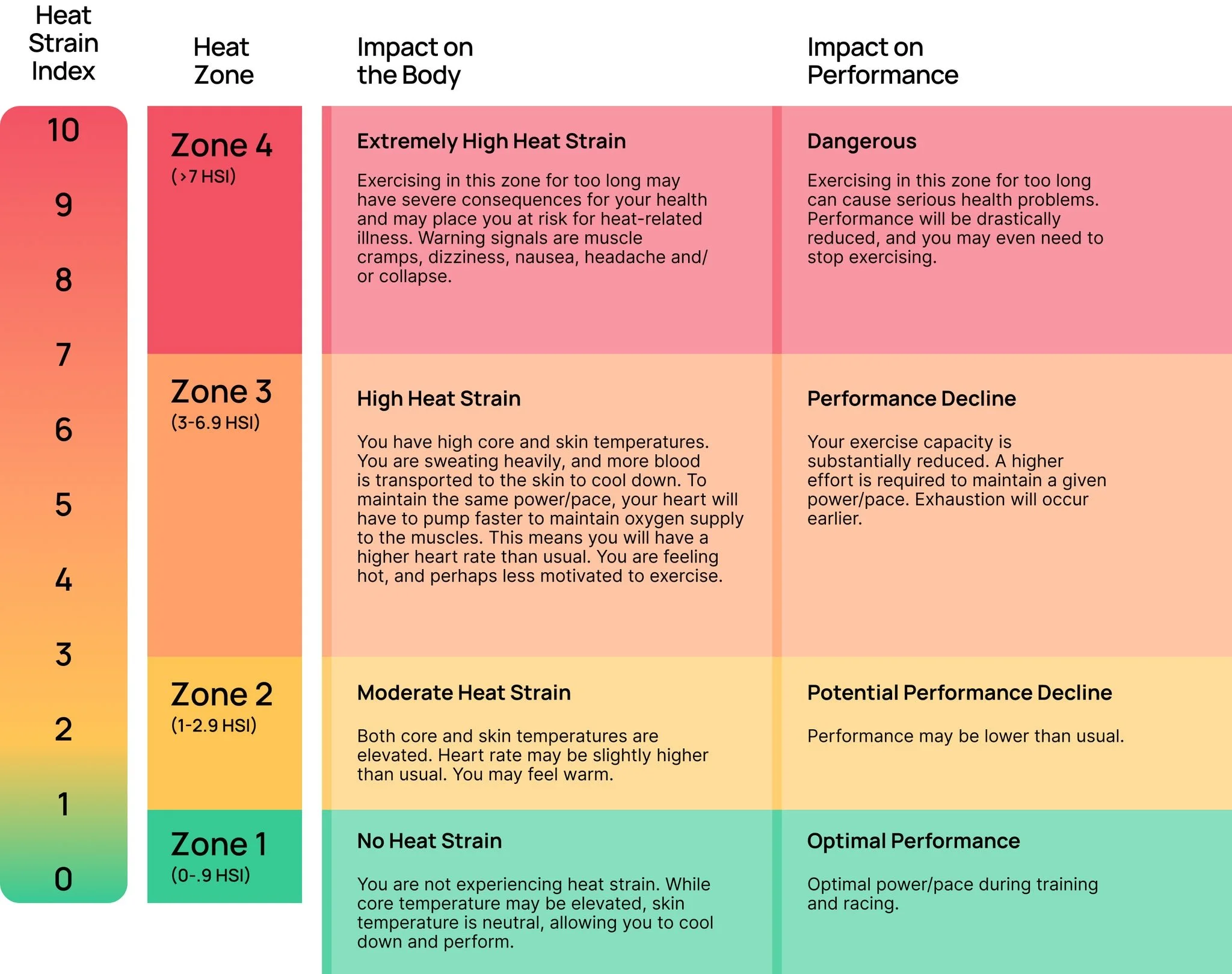
CORE’s Heat Strain Index converts estimated mean body temperature into a value ranging from 0 to around 10. It gives a real-time, minute-by-minute measure of how hard your body is working to stay cool.
Preventing Performance Loss and Guiding Heat Training
When high performance is desired, such as during competition and high-intensity training sessions, the Heat Strain Index can be used to limit performance loss.
Keeping Heat Strain Index low (for example, through cooling or pacing adjustments) ensures that no blood is diverted away from the muscles.
Heat Strain Index can also be used to guide heat training. Regular and repeated heat training sessions at an elevated Heat Strain Index for 45–80 minutes results in heat adaptation.
If you are interested in learning more about Core Body Temp Sensor, please click the link below. Feel free to reach out to me if you have any questions regarding how this device can significantly improve your racing and training performance.
The Three-Week Heat Acclimation Protocol
The following protocol layers into a normal training week without requiring a complete program overhaul. The foundation is the traditional methods described above: hot room sessions, layering on appropriate days, and passive heat exposure post-workout. A CORE sensor, if available, adds a precise monitoring layer throughout each phase -- but heart rate and perceived exertion work well as the primary guides if that is what you have.
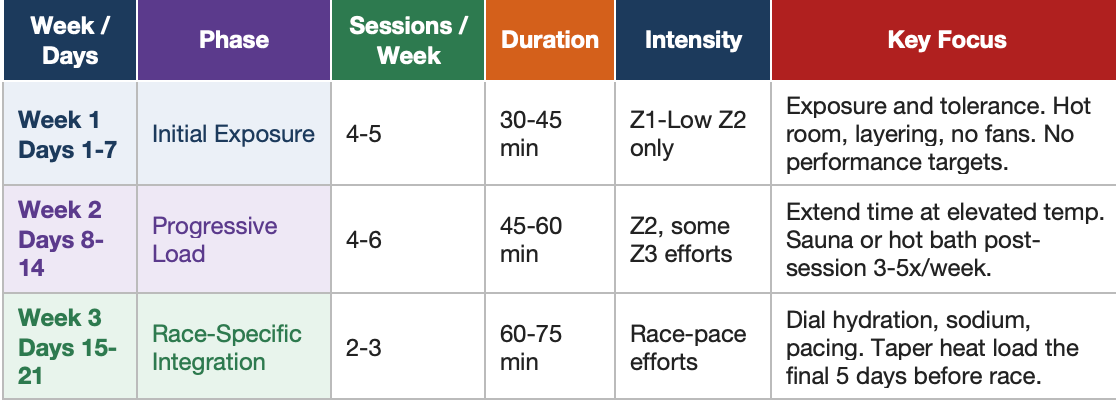
Week 1: Initial Exposure (Days 1-7)
The first week is about building tolerance, not performance. Schedule four to five sessions of 30 to 45 minutes at easy intensity -- Zone 1 to low Zone 2. Use a hot room, train outdoors at midday, or wear an extra layer on cooler days. Turn off the fan on trainer sessions. The goal is simply to let the body experience elevated thermal load repeatedly without pushing it into distress.
This phase sets the foundation. Athletes who rush through it by training too hard too early experience excessive fatigue and lose the adaptive benefit. Keep intensity easy, keep the schedule consistent, and add a 15 to 20 minute post-session sauna or hot bath two to three times this week if access allows.
Week 2: Progressive Load (Days 8-14)
With baseline tolerance established, Week 2 introduces moderate effort. Four to six sessions extend to 45 to 60 minutes, with small amounts of Zone 3 work in the back half of sessions. The signs of early adaptation will be visible: sweat onset arrives sooner, and heart rate at a fixed effort begins to normalize compared to Week 1.
This is also the week to bring passive heat exposure to its full dose: sauna or hot bath for 20 to 30 minutes, three to five days per week, consistently post-exercise. Apply the 10 to 20 minute delayed rehydration window each time. Athletes using a CORE sensor can begin actively targeting the 38.0 to 38.5 degree C range and logging time in zone.
Week 3: Race-Specific Integration (Days 15-21)
The final week bridges acclimation to race-day execution. Two to three heat sessions per week now include race-pace efforts -- tempo bricks, race-effort runs, or race-pace bike intervals conducted in warm conditions. This is where the hydration protocol gets dialed in: sodium intake, fluid volume, and timing should reflect actual sweat rate and the conditions expected on race day.
Taper the heat load in the final five days before any target race. Drop to one easy passive session or omit active heat entirely. The adaptation is fully banked -- the body needs recovery and readiness now, not more thermal stimulus.
Where Heat Acclimation Fits in Your Race Build
Heat acclimation doesn't require sacrificing training quality -- it requires smart substitution. The three-week protocol integrates most naturally by replacing two to four easy sessions per week with heat-targeted alternatives. Protect the key sessions: high-intensity intervals and quality long runs stay in normal conditions. Use heat as a tool on recovery and aerobic days.
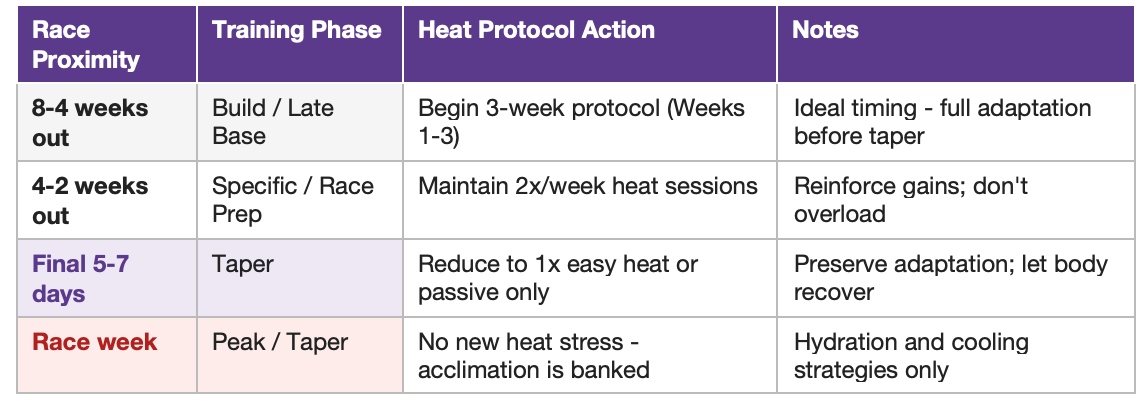
If your race is in a hot climate and home training conditions are cool, plan the three-week block to finish no later than five to seven days before race day. From that point, the priority shifts to hydration execution, pacing discipline, and cooling strategies on race morning. The adaptation is already in place -- the job in race week is to arrive rested and ready to use it.
I have used a 4 week model of this with my triathletes on the Northeastern University Triathlon Team for the Olympic distance race at the USAT Collegiate Club National at Miami in 2025. Coming from the northeast in March we had no chance to get use to training in the heat and humidity so we had no choice but to implement such a program to help ensure success at the event. The result: a 13th place overall finish in the country — a program-best performance built on structured preparation, not luck. Use the link below to get the exact 4 week protocol the team used with great success.
Safety: Non-Negotiable Boundaries
Heat acclimation works because it is controlled stress -- not survival training. Discomfort is part of the stimulus; distress is a signal to stop immediately. Athletes should exit any heat session -- active or passive -- if they experience dizziness, lightheadedness, chills or goosebumps during exposure, unusual fatigue or weakness, or nausea. These are early warning signs of heat illness, not signals to push through.
Athletes with cardiovascular conditions, hypertension, or a history of heat-related illness should consult a physician before beginning any structured heat acclimation protocol. No athlete should use a sauna or whirlpool alone -- always have another person nearby. And never skip the natural cooling and intentional rehydration sequence after passive heat exposure.
Heat adaptation should feel like productive discomfort -- not emergency. If an athlete cannot carry on a basic conversation during a heat session, the load is too high.
Common Mistakes to Avoid
Starting too hard, too early. Training at normal intensity in the heat leads to excessive fatigue, impaired recovery, and a stimulus that overwhelms rather than adapts. Week 1 is exposure -- not performance.
Waiting until race week. A 21-day process started seven days before race day delivers one week of early-phase adaptation with none of the performance payoff. Plan the block to finish well before the taper begins.
Treating heat like dehydration training. The delayed rehydration window after passive exposure is a targeted 10 to 20 minute signal -- not an invitation to chronically under-hydrate. Hydration during and after active sessions must remain adequate and individualized.
Overusing passive heat without structure. More is not better. Daily sauna use without adequate recovery between sessions blunts the adaptation signal. Two to five post-exercise sessions per week is the evidence-supported range. Adaptation consolidates during rest.
Layering on hard sessions. Layering belongs on easy and aerobic days only. Adding thermal stress on top of a key interval session or long run raises heat illness risk without proportional benefit. Hard sessions stay in normal conditions.
The Bottom Line
Heat acclimation is one of the most trainable performance variables in endurance sport -- and unlike many fitness gains that take months to accumulate, meaningful adaptation comes in weeks. It transfers directly to race-day performance and separates athletes who planned ahead from athletes who were hoping for a cool day.
The barrier to entry is low. A warm room, a set of extra layers, and a consistent post-workout sauna or hot bath routine are enough to drive real physiological change. For those who want to monitor and prescribe heat stress with the same precision applied to power or pace, tools like the CORE sensor extend that capability -- but the foundation is built with free, simple methods that any athlete can start this week.
Two to four heat sessions per week. A minimum of 10 to 21 days. Controlled intensity. Add passive heat where possible. Track adaptation by feel, heart rate, or core temperature. That is the protocol -- and it works.
Ready to Build Your Heat Edge?
Heat acclimation is one of the few performance gains you can build in weeks -- but it has to be planned, not improvised. At Catalyst Endurance, we integrate heat protocols directly into your periodized training plan, timed to your race calendar and matched to your training environment and schedule.
If you're racing in warm conditions this season and want a structured plan that accounts for heat adaptation, hydration strategy, and race-day thermal management -- let's talk.
Schedule a Free Coaching Consultation