Transitions: The Free Speed Hiding Between Disciplines
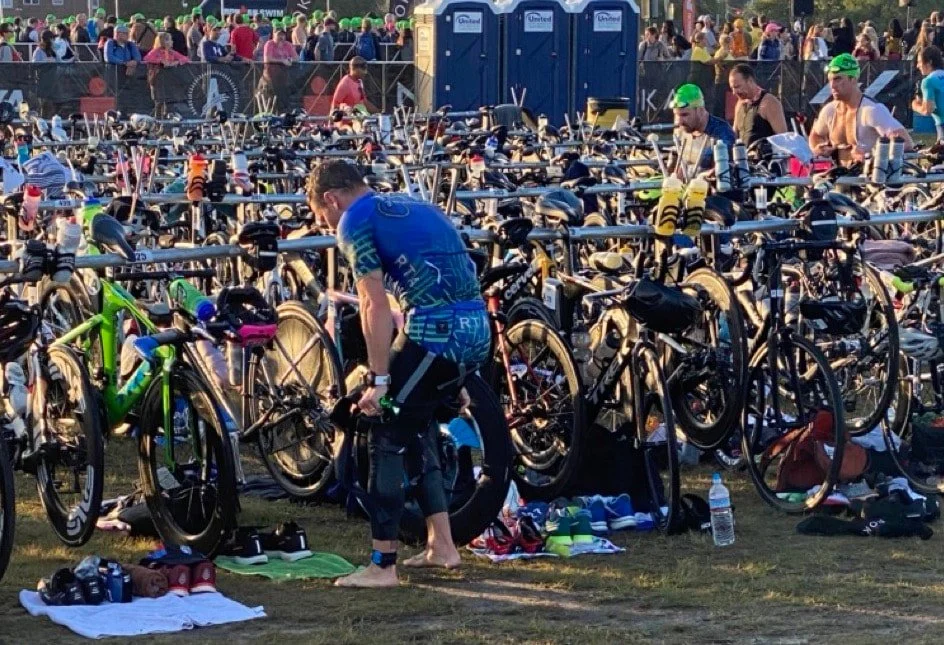
Triathlon has three disciplines on the entry form and a fourth one almost nobody trains for: transitions. T1 and T2 don't test your fitness — they test your setup, your rehearsal, and how you handle a spiking heart rate under time pressure. And unlike squeezing another minute out of a bike split, transition time is almost entirely free. It doesn't cost fitness. It costs organization and repetition.
This post covers what actually moves transition times: why they matter more than most athletes assume, how to set up your spot, the specific sequence for T1 and T2, and how to practice until the whole thing is automatic.
Why transitions decide races
On paper, transitions look small. In an Olympic-distance race, T1 accounts for well under one percent of total time and T2 even less. But time spent in transition correlates with final placing more than that tiny percentage would suggest — one study of Olympic-distance racing found lost time in T1 and T2 each correlated with final result, and that losing less time specifically in T2 was linked to a better overall finish (Cejuela et al., 2013).
In plain terms: that number measures how closely two things move together, on a scale from 0 (no relationship) to 1 (a perfect one). A 0.43 is a moderate, real relationship — as time lost in T2 goes up, final placing tends to get worse — but it's far from the only thing deciding the result. Squaring it gives a rough sense of scale: 0.43² ≈ 0.18, so lost T2 time tracks with about 18% of the variation in how athletes finish. That leaves plenty to swimming, cycling, running, and pacing. The takeaway isn't that T2 decides your race — it's that T2 is one of the few levers correlated with the result that you can pull for free, without any extra fitness.
The shorter the race, the more transitions matter proportionally. A 2025 analysis of over 4,000 elite performances across Super-Sprint, Sprint, and Olympic-distance World Triathlon Series racing found T1 was one of the most influential segments on final position at Sprint distance — more influential than running — and especially significant for female triathletes, where a strong T1 is often what determines whether an athlete can bridge into the lead bike pack at all (Martínez-Sobrino et al., 2025). As short-course, draft-legal racing has grown, researchers have specifically pointed to efficient cycling-to-running transitions as a defining separator among elite competitors (Walsh, 2019).
None of that requires a faster swim, bike, or run. It requires a transition you've actually rehearsed.
Set up your transition spot like you mean it
Most lost time in transition isn't physical — it's searching, hesitating, and re-doing something you didn't lay out right the first time. Before you ever hit the water, walk the transition area and memorize a landmark near your spot: a specific pole, a flag color, a portable toilet — something faster to spot under stress than counting rows.
Lay gear out in the order you'll use it, and keep the footprint small. A single towel marking your space, with helmet, sunglasses, and shoes arranged in the sequence you'll grab them, beats a small yard sale every time. Walk the actual path — swim exit to your spot, your spot to the mount line, dismount line back to your spot — so none of it is a surprise on race morning.
T1: swim to bike
Many race rules (ITU) require your helmet buckled before you touch your bike — make that sequence automatic in practice so it's never a race-morning penalty. And go easy on ambition with the mount: flying mounts save real seconds, but they also carry real fall risk if you haven't rehearsed them extensively in an empty lot first. If in doubt, take the standard mount and make it fast through repetition instead.
T2: bike to run
The bike-to-run transition rewards the same principle as T1: decide your sequence in advance and rehearse it until it's automatic. Slow down and get your feet out of your shoes before the dismount line if you haven't specifically practiced a flying dismount — a fall here costs far more time than a conservative dismount ever will.
Once you're running, expect your legs to feel heavy and your stride to feel off for the first few minutes. That's the normal physiological cost of the bike-to-run transition, not a sign anything is wrong. Settle into your pace rather than trying to sprint out of transition to compensate.
- Lube ankles and wrists pre-race so the wetsuit strips fast
- Unzip and start peeling from the top down while still moving toward your spot
- Sequence: helmet on and buckled, then sunglasses, before you touch the bike
- Standard mount unless you've specifically drilled a flying mount
- Advanced only: shoes clipped into the pedals in advance, mounting with feet on top and sliding in once up to speed
- Feet out of shoes before the dismount line unless you've drilled a flying dismount
- Elastic laces or toggles remove tying time entirely
- Advanced only: pulling feet out and riding the last stretch with feet on top of the shoes, dismounting with shoes left clipped to the pedals
- Expect heavy, awkward first strides — that's normal, not a form breakdown
Practice makes it automatic
You wouldn't race a marathon without long runs, and you shouldn't expect a fast transition without practicing it specifically. Build brick workouts that include a real mock transition — not just bike, then run, back to back, but the actual dismount, gear change, and run-out you'll do on race day.
Time yourself with a stopwatch in a parking lot. Run the exact motions you'll use on race day, then look for the seconds you can trim — one rep at a time, not all at once. The goal on race day isn't rushing; it's smoothness. Panicking through a transition costs more time than it saves, and it raises your risk of a mistake right when your heart rate is already spiking from the discipline you just finished.
Race-day execution
On race morning, walk the transition area again so the layout isn't new information under pressure. Use a mental checklist rather than trying to consciously manage every motion — the rehearsal is what makes that possible. Stay calm, breathe, and let the practice take over. Smooth is fast.
Train with purpose
None of this requires new fitness. It requires a transition spot you've thought through, a sequence you've rehearsed until it's automatic, and the composure to execute it at race pace instead of panic pace. That's free speed — available to every athlete, regardless of how the swim, bike, or run went.
References
Cejuela, R., Cala, A., Pérez-Turpin, J. A., Villa, J. G., Cortell, J. M., & Chinchilla, J. J. (2013). Temporal activity in particular segments and transitions in the Olympic triathlon. Journal of Human Kinetics, 36, 87–95.
Martínez-Sobrino, J., Santos del Cerro, J., González-Ravé, J. M., & Veiga, S. (2025). Influence of triathlon segments and transitions on elite performance by distance and sex. Journal of Human Kinetics.
Vleck, V. E., Bentley, D. J., Millet, G. P., & Cochrane, T. (2008). Pacing during an elite Olympic distance triathlon: Comparison between male and female competitors. Journal of Science and Medicine in Sport, 11(4), 424–432.
Walsh, J. A. (2019). The rise of elite short-course triathlon re-emphasises the necessity to transition efficiently from cycling to running. Sports, 7(5), 99.