Race-Day Warm-Up: Getting Ready to Race, With or Without the Water
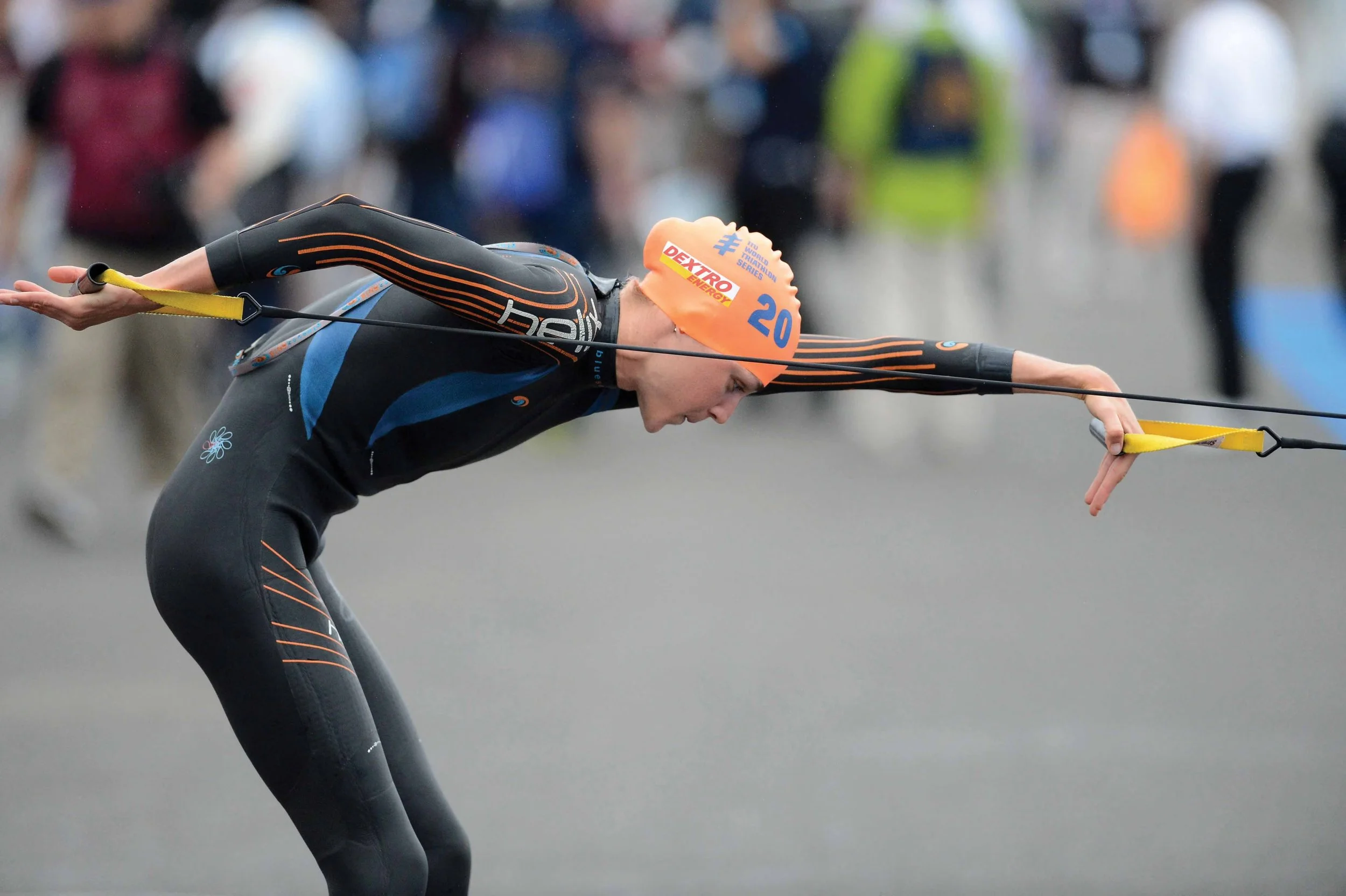
This closes out our race-execution series. We've covered run mechanics, bike handling skills, open-water swim skills, and transitions — if a question comes up about the movement or setup side of any of those disciplines while you're reading this, those posts are the place to go back to. This one ties it together: the warm-up that gets your body and mind ready to actually use everything you've trained.
Every race director makes a different call on whether you can get in the water beforehand. Point-to-point swims, mass-participation races, and cold-water events often say no. Smaller races with early course access often say yes. Since you won't always control that, this post covers both situations — plus what the research actually says about warm-ups, which turns out to be more nuanced than “more is always better.”
Why warm-up matters (and where the evidence gets interesting)
The standard assumption is that skipping a warm-up sabotages your swim. The research is more surprising than that. One study compared a swim-only warm-up, a run-swim warm-up, and no warm-up at all before a simulated sprint triathlon, and found no significant difference in swim, bike, run, or overall time between any of the three conditions (Binnie et al., 2012). The likely explanation: the swim leg itself functions as a warm-up for the bike and run, and moderately trained triathletes may not need an elaborate pre-race routine to swim well. A key to remember is that the warm-up is not just to get the body, the muscles, joints and tendons ready, but also the mind ready so you can start neurologically primed and ready to go once the horn sounds.
That doesn't mean warm-ups are pointless — it means panic isn't warranted if you can't do the warm-up you planned. Meanwhile, a survey of national- and international-caliber triathletes and coaches found many athletes doing far more than research supports: an average total warm-up time of 90 minutes, against the 62.5 minutes coaches themselves suggested, with only about a third of athletes including race-specific conditioning work in the ideal window shortly before their start (Quagliarotti et al., 2024). Longer and earlier isn't automatically better — timing matters as much as content, and we'll come back to that.
The universal warm-up principles
Regardless of whether you get in the water, the same structure applies. Raise your heart rate gradually with a few minutes of easy movement. Mobilize the joints you're about to ask a lot of — hips, shoulders, ankles — with dynamic movement rather than static stretching. Then prime the system with a few short efforts at or near race intensity, just enough to wake up the right muscle fibers without creating fatigue. Keep the whole thing purposeful, and finish close to your start time rather than well ahead of it.
Scenario 1: in-water warm-up is allowed
If you have water access, use it — but briefly and with a purpose, not as a long session that burns energy you need for the race. A short warm-up covers what land can't simulate: getting a feel for sighting your first buoy, adjusting to water temperature, getting a sense of currents and tides and a couple of short accelerations to prime your stroke.
A simple version: 3–5 minutes of easy, relaxed swimming to acclimate and elevate your heart rate, followed by 2–3 short efforts of 15–20 strokes at close to race effort. That's enough. Remember that even a full no-warm-up condition didn't hurt performance in trained triathletes (Binnie et al., 2012) — so there's no need to turn this into a long session out of anxiety. Exit with enough time to towel off, get your wetsuit resituated, and walk calmly to the start.
Scenario 2: no in-water warm-up is allowed
Plenty of races don't allow it, and that is not the disadvantage it feels like. A systematic review of land-based warm-up strategies for swimmers found that reducing the gap between any pool-based preparation and race start consistently produced faster times, and that dryland and even passive strategies (like extra warm layers kept on until just before the start) helped preserve some of a warm-up's benefit when time in the water wasn't available (McKenzie et al., 2022).
- 3–5 min easy, relaxed swimming to acclimate and raise heart rate
- 2–3 short efforts of 15–20 strokes at close to race effort
- Don't over-do it — even no warm-up didn't hurt trained triathletes
- Exit with time to towel off and walk calmly to the start
- Easy jog or jump rope to raise heart rate
- Resistance-band or tubing work mimicking your pull pattern
- Dynamic arm circles and hip mobility
- Visualize your first 200m — sighting, settling, finding rhythm
- Keep warm layers on until close to your start time
Build your dryland version around the same raise-mobilize-prime structure: a few minutes of easy jogging or jump rope to raise your heart rate, resistance-band or tubing work mimicking your pull pattern to activate the shoulders and lats, dynamic arm circles and hip mobility, and a minute of visualization walking through your first 200 meters — sighting, settling into your pace, finding your rhythm. Keep warm layers on until close to your start time so you're not standing around cooling back down.
Combined with the earlier finding that a full no-warm-up condition didn't hurt trained triathletes in simulated racing (Binnie et al., 2012), the honest takeaway is this: a calm, well-rehearsed dryland routine is a completely adequate substitute when the water isn't available. It's not a compromise — it's simply the plan for that race.
Scale it to your race distance and conditions
Warm-up needs shrink as race distance grows. At sprint distance, where you're at high effort within minutes of the start, a longer and more deliberate warm-up pays off — it gets your aerobic system primed before you need it, and well-trained athletes can handle more of it without paying for it later. At 70.3 and full-distance racing, the swim itself works as warm-up for the bike, and the bike works as warm-up for the run; keep your actual pre-race routine to muscle activation and getting acclimated to the water, and protect your energy stores and core temperature for the miles ahead instead.
- High intensity from the gun rewards a longer, more deliberate warm-up
- Include a few short efforts at or above race pace in each discipline
- Well-trained athletes can handle more volume here without it costing them later
- The swim warms you up for the bike; the bike warms you up for the run
- Keep the actual warm-up to muscle activation and water acclimatization
- Protect glycogen and core temperature for the miles still ahead
Ambient temperature shifts the plan too. In cold water or cold air, extend your warm-up somewhat so your muscles genuinely get warm, and lean more on dry land if a pre-swim chill is a concern — you can always warm back up once you're moving. In hot conditions, shorten it: the last thing you want is to raise your core temperature before the gun even goes off. If conditions are cold and you do get in the water, pouring a little warm (not hot) water into your wetsuit before you enter softens the initial shock. And if you're relying on stretch cords or resistance bands for dryland arm activation, practice with them in training first — race morning is the wrong time to discover how your shoulders respond to a tool you've never used.
Timing it so it actually helps
However you warm up, when you finish matters. A study measuring 200-meter freestyle performance after a 10-minute versus a 45-minute recovery period found swimmers were meaningfully faster off the shorter gap, with core temperature better maintained closer to the start.
The practical version: don't finish your warm-up 45 minutes before your wave because that's when the schedule happened to have you free. Time it to land in roughly the 5-to-20-minute window before your actual start, and use any standing-around time at the front of that window, not the back of it. The walk to your wave is part of the plan, not dead time.
Race mornings rarely allow one continuous warm-up block anyway — transition setup, mandatory briefings, and check-in cutoffs get in the way. A broken warm-up is completely fine: a bike warm-up well before transition closes, a run warm-up after your gear is set, then your swim warm-up last since it's the most race-specific and closest to your start. Just try to keep any single gap between pieces under about 20 minutes, so you're not starting from scratch each time.
A simple warm-up for either situation
You don't need anything elaborate. Here's a straightforward version of each — about 15 minutes, easy to remember, and easy to actually do on a nervous race morning. Note no bike warm-up is included as most races do not allow it, ie 70.3 and Ironman races, or it is difficult to do due to overall race logistics. That said, make sure your bike is working perfectly mechanically and is set to the proper gearing to allow you to smoothly accelerate coming out of T1.
- Walk or light jog — 3 min, to raise your heart rate
- Dynamic mobility — 3 min: arm circles, leg swings, hip openers
- Easy, relaxed swim — 3–4 min, to acclimate to the water
- 2–3 short accelerations — 15–20 strokes at race effort, easy recovery between
- Exit, towel off, walk calmly to the start
- Easy jog or jump rope — 3 min, to raise your heart rate
- Dynamic mobility — 3 min: arm circles, leg swings, hip openers
- Stretch cord or resistance band pulls — 3 min, mimicking your swim stroke
- A few strides or easy spin-ups — 2 min, at race effort
- One minute of visualization — picture your first 200m: sighting, settling, finding rhythm
Neither version needs to be perfect. What matters is that it's the same routine every time — practice it before a few key training sessions so it's familiar rather than new information on race morning.
Train with purpose
Five posts, one race. Run mechanics, bike handling, open-water skills, transitions, and now the warm-up that ties it to the start gun — none of it demands more fitness than you already have. It demands a plan you've rehearsed enough times that race morning feels familiar instead of uncertain, whatever the rules on the water happen to be that day.
References
Binnie, M. J., Landers, G., & Peeling, P. (2012). Effect of different warm-up procedures on subsequent swim and overall sprint distance triathlon performance. Journal of Strength and Conditioning Research, 26(9), 2438–2446.
McKenzie, M. R., McKean, M. R., Doyle, D. P., Hogarth, L. W., & Burkett, B. J. (2022). Swimming performance, physiology, and post-activation performance enhancement following dryland transition phase warmup: A systematic review. PLoS ONE, 17(8), e0273248.
Quagliarotti, C., Villanova, S., Marciano, A., López-Belmonte, Ó., Caporali, C., Bottoni, A., Lepers, R., & Piacentini, M. F. (2024). Warm-up in triathlon: Do triathletes follow the scientific guidelines? International Journal of Sports Physiology and Performance, 19(12), 1473–1479.
West, D. J., Dietzig, B. M., Bracken, R. M., Cunningham, D. J., Crewther, B. T., Cook, C. J., & Kilduff, L. P. (2013). Influence of post-warm-up recovery time on swim performance in international swimmers. Journal of Science and Medicine in Sport, 16(2), 172–176.